
The last three newsletters were about a kind of false ala rm — the body bracing for a loss that isn’t actually coming, treating an ordinary disagreement as if it were the end of a relationship. Most of the time, that’s exactly what it is: a false alarm, worth talking your nervous system down from.
 to one or both of you. Sometimes someone you love decides closeness with you isn’t worth the discomfort of your difference, and they leave. That isn’t a misfiring nervous system. That’s a real loss, and it deserves to be treated as one.
I want to be just as clear here as I’ve been in the last two pieces about what my role is and isn’t. I’m not the right person to walk you through the relationship itself, and I won’t pretend to be. But this kind of loss impacts the body, the same way the fear of it does — and what I see in the office, often months or years after the relationship has already ended, is a body still holding a tension pattern that was never allowed to release. That part is in my lane, and it’s worth talking about directly.
Grief and Fear Live in the Body Differently
 Real loss is different. There’s nothing left to prepare for. The bracing has done its job, or failed to prevent what it was bracing against, and now there’s just the loss itself, sitting there.
The trouble is, a body that’s spent months or years in  protective bracing doesn’t always know how to put that bracing down once the thing it was guarding against has already happened. You can end up carrying the posture of a fight that’s already over — shoulders still raised, jaw still tight, breath still shallow, long after the relationship itself is gone. The threat is no longer in front of you. The body hasn’t gotten the memo.
This can be a challenge to identify, because what should be grief often shows up as other feelings. Grief is the feeling o f letting go. But when you can’t let go because you are holding on to a judgment or you just don’t understand why the separation happened, feelings of anger, frustration, resentment, and even hopelessness can take the place of grief. These feelings would be signs of unresolved grief over a loss.
This is worth naming plainly: grief over a relationship lost to difference is still grief, even when no one died, even when the other person is still alive and well and simply not in your life the way they used to be. It’s a real loss, and it asks for real grieving, not just a return to baseline tension.
What Tends to Help
I won’t provide you with a script for grief because ther e isn’t one, and anyone offering you one is essentially selling you something. However, there are a few important things to acknowledge, as they often go unnoticed in this particular type of loss—the kind that arises from a disagreement rather than a death. This seemingly trivial difference somehow makes people feel less entitled to grieve it.
Let it be acknowledged as a genuine loss. People often downplay this specific type of grief because the other person is still alive, still present, and technically reachable. However, this doesn’t diminish the magnitude of the loss. A relationship that has ended is truly over, whether the person involved has passed away or simply walked away. Your body doesn’t categorize grief based on its nature.
Notice if you’re still bracing for something that’s alrea dy happened. If the thing you feared, like withdrawal, distance, or silence, has already occurred, ask yourself honestly if your shoulders and jaw are aware of it yet. Sometimes, simply naming it plainly, even out loud to yourself, like “this already happened, I don’t need to keep guarding against it,” gives the body permission to relax and let go of the tension it’s been holding on to.
Don’t let grief turn into self-blame about your differ ences. It’s easy to transition from “I lost someone” to “I lost someone because I wasn’t willing to become what they needed me to be,” as if the solution was always within reach, if only you had been willing to pay the price. While it’s sometimes a valid question to ponder, it’s generally not that simple. Embracing your own differences as something valuable, even at a significant cost, doesn’t equate to wrongdoing. In truth, if you give up who you are to hold on to a relationship, the relationship has ended just the same. Only now you are the one that has left. Only your pretend self is having the relationship, not you.
Allow your body to be an integral part of your processing, not just your mind. Incorporate movement, breath, and time spent outdoors into your routine. These simple activities can he lp alleviate the burden you’re carrying. Grief that is solely confined to thought, without any physical manifestation, tends to transform into chronic tension that manifests months later. Too often such unresolved grief disturbs bodily functions and eventually manifests as disease.
Where This Leaves Us
Across these four pieces, the recurring theme is that most relational tension stems from the fear of an unfulfilled loss. The initial two skills focused on helping the body distinguish between potential threats and stand firm when necessary. How ever, some losses are indeed real, and in such cases, the objective is not to convince the body to remain in a defensive posture but rather to allow it to complete its natural response, rather than enduring a blow that has already occurred.
Both are forms of the same thing, ultimately: aligning your body’s response with the actual truth, rather than what an  old, understandably cautious part of you assumes must still be true. This alignment—body and reality working together, rather than in opposition—is, in my experience, where most of the tension I treat actually resolves. The muscular tension that causes abnormal motion and pain is often a reflection of internal conflict. The muscles receive two conflicting messages simultaneously—one based on our desires and beliefs, and the other based on the reality that confronts us. To achieve ease and internal harmony, we must relax into the truth of our experiences. Simply be present with what is. Grieving is an essential part of this process, allowing us to confront and accept the reality of our situation, even when it hurts.
Take care,
David
Ellen
Ellen has settled in at her new skilled nursing facility.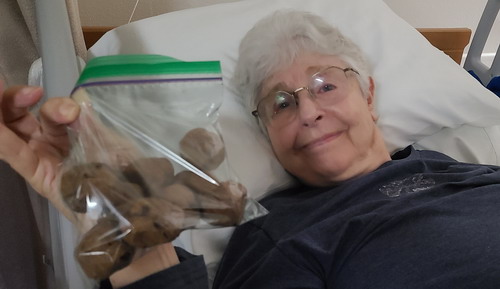 The pace is much slower with about one third as much PT and OT each day. The acute rehab was too much. Here we see Ellen being delighted at the protein balls I make for her. She needs some extra protein in order to heal. Each ball gives her an extra 8 grams of protein. Plus I bring her a protein shake each day for an extra 35 grams of protein.
Chronic Fatigue Syndrome news
New research is finding that Chronic Fatigue Syndr ome may be tied to a malfunction in the doorways (receptor sites) on many cells that control the movement of calcium into the cells. CFS has been hard to study, and this gives some new opportunities to figure a way to shift this disease.
___________________________
~David DeLapp
_____________________________________
Swimming for chronic low back pain
Although swimming has long been prescribed for low back pain rehabilitation, no one has actually studied to see if it d oes any good. Now they have. In folks with low back pain of more than12 weeks duration it was found that swimming 30 to 45 minutes three times per week reduced low back pain by an average of 50%.
____________________________
“Optimism – not a childish hope that something good will happen, but the belief in your own skills to adapt and create good things from life. “
~David DeLapp
________________________________________
Some gut bugs may promote diabetes
Six different gut bug have been identified as helping to promote diabetes. Of particular interest is one bug usually  associated with doing good things – A. Muciniphilia. While usually promoting health, if it get hungry because we are not eating enough fiber, it start eating away the protective mucus lining of the gut allowing nasty inflammation causing bacteria to get to the gut wall, which then promotes diabetes. Folks eating only 20 grams of fiber a day saw this happening. How much fiber are you eating daily?
“Generosity builds your internal sense of abundance. When you give freely you come to see that you have an infinite supply of gifts to give to the world.“
~David DeLapp