Key concept: Movement is a habit we build a tiny bit at a time
 Most people don’t need another lecture about exercise. They already know they should exercise. They’ve heard it from their doctor, their family, television, and every health website they’ve ever visited.
The problem isn’t knowledge.
The problem is getting started.
If you’ve spent decades living a relatively sedentary life, suddenly being told to exercise 30–45 minutes every day can feel like being asked to become a completely different person. That may not be the best way to approach the problem. Instead, let’s think about progression.
 Step 1: Get off the couch
For someone who is very inactive, simply standing up more frequently is meaningful.
Stand while talking on the phone.
Walk to the mailbox.
Get up during television commercials.
Do a few chair stands.
Take a two-minute walk around the house.
These activities may seem insignificant compared with a workout. But they have one enormous advantage:
You can actually do them.
Step 2: Turn movement into a habit
 Once you have established a consistent routine of movement, you can begin incorporating “exercise snacks” to build on that momentum.
For example:
Morning: 3 minutes of walking
Late morning: 3 minutes of movement
After lunch: 5–10 minutes of walking
Afternoon: 3 minutes of movement
After dinner: another short walk if appropriate
You haven’t gone to the gym. You haven’t put on special clothes. You haven’t committed to an hour of exercise.
But you’ve interrupted several hours of sitting with movement.
And recent research suggests that these brief, repeated exercise bouts can improve fitness and physical function.
Step 3: Make the movement more challenging
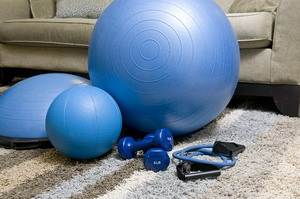 Once short periods of movement become easy, gradually increase the challenge.
Walk faster.
Walk farther.
Add hills.
Do more chair stands.
Add resistance bands.
Try gentle rebounding.
Swim for longer.
The progression should be gradual enough that you finish thinking:
“I could probably do that again tomorrow.”
That’s exactly what we want.
Step 4: Add resistance exercise
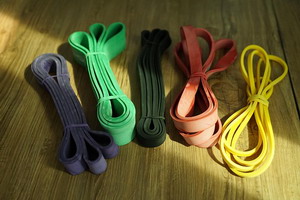 At some point, we want to deliberately challenge the muscles. This can still be done at home.
Chair stands, squats, wall push-ups, resistance bands, light dumbbells, heel raises, and other simple exercises can provide resistance. The goal is to prevent the gradual loss of muscle that makes everyday activities increasingly difficult. Remember:
Your muscles are metabolic organs.
Keeping them strong helps your body handle glucose and maintain physical independence.
Where does whole-body vibration fit?
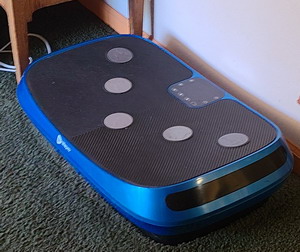 Whole-body vibration may be useful for people who have difficulty beginning conventional exercise. A vibration platform creates rapid, small movements that stimulate muscles and sensory receptors. It isn’t a replacement for conventional resistance or aerobic exercise. But research in older adults with sarcopenia (muscle loss) has found improvements in lower-body strength and physical performance, although it has not consistently increased muscle mass. A 2026 systematic review concluded that whole-body vibration may be a useful adjunct, particularly for people with limited exercise tolerance. (A link to the vibration plate I have used for the last 6 years can be found in the version of the article on my web page here. )
That gives us an interesting possibility. Rather than thinking:
“I’m going to use vibration instead of exercising,”
think:
“I’m going to use vibration to help me become capable of exercising.”
You might begin by simply standing on the platform.
Then add weight shifting.
Then heel raises.
Then supported squats.
Then chair stands.
Then walking.
The machine becomes a bridge, not the destination.
And eventually, perhaps, intervals.
 Once your fitness improves, there is another option: short periods of higher-intensity exercise. High-intensity interval training, or HIIT, alternates periods of harder exercise with recovery periods. There is even a very short form called REHIT—Reduced-Exertion High-Intensity Interval Training—which uses only a few very short, intense efforts. This can be an efficient way for a reasonably fit person to improve cardiovascular fitness.
But it isn’t where I would begin with someone who has been sedentary for years.
Build the foundation first.
 Walking.
Swimming.
Rebounding.
Resistance exercise.
Exercise snacks.
Then intervals if appropriate.
Your exercise program should fit your life.
You don’t have to exercise at a gym.
You don’t need expensive equipment.
You don’t have to become an athlete.
 Your home may already contain everything you need to begin:
A chair.
A wall.
A staircase.
Your own body.
A pair of walking shoes.
Perhaps a resistance band.
Perhaps a pool.
Perhaps a mini-trampoline.
Perhaps a vibration platform.
 The equipment isn’t the most important part. Consistency is. The goal isn’t to become an exerciser overnight.
If you’ve spent 40 years being a couch potato, don’t expect yourself to undo that habit in 40 days. Think of this as rehabilitation. You are teaching your body—and your brain—that movement is normal again.
Start so small that you cannot reasonably tell yourself you can’t do it.
Then repeat it.
Then add a little.
Then repeat that.
Eventually, something remarkable can happen:
 Exercise stops being something you have to make yourself do. It simply becomes part of your day. And that may be the most important exercise goal of all.
Not becoming a gym rat.
Not running a marathon.
Not losing a certain number of pounds.
But becoming a person who moves regularly. Because the body is remarkably adaptable. Give it a reason to move, give it appropriate nutrition, and give it enough time—and even an old couch potato can begin becoming more capable again.
Take care,
David
Colloidal Silver is back and available in the office. Silver has quadrupled in price over the last two years, so the price we have it for in the office is a real steal!
Ellen
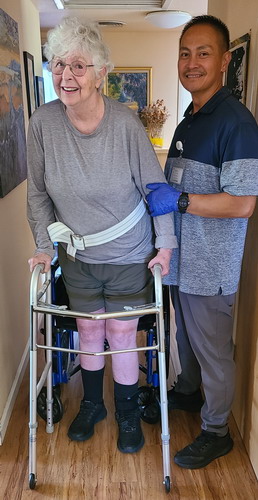 I was home working on this newsletter while the physical therapist was pushing Ellen well past her believed limits. A little salty language may have escaped in the experience. As you can see, he was getting Ellen to “walk” (shuffle) using a walker while he stabilized her with a big belt. She managed 17 steps! She then demanded carrot cake as a reward…
Turning waste plastic into food
 By genetically altering various microbes scientists are making them able to eat waste plastics and turn them into proteins and fats that could then be mixed with agricultural waste turned into starches and the whole mess turned into edible biscuits. They say these are safe to eat!
___________________________
“When you hold on to an attitude or belief about life and people that conflicts with your experience, you block your ability to develop a new version of self that can adapt to what is more effectively.“
~David DeLapp
_____________________________________
Why overuse injuries keep coming back
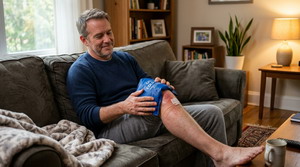 Rest and ice will treat the flareup of pain, but they do not address the real issue. In fact, rest and ice actually make the injured tendons and ligaments weaker. The painful inflammation is what draws the repair cells to the injured area to rebuild it. These tissues need to be carefully stressed to trigger remodeling and rebuilding.
____________________________
“The problem with judgment is that it reduces your experience to the single dimension of right and wrong, good and bad, or black and white. This reduces your perceived options for participation to that single dimension. Reality is multidimensional and filled with millions of colors, and you can choose any of them as a way to participate.“
~David DeLapp
________________________________________
Seating choices affect back health
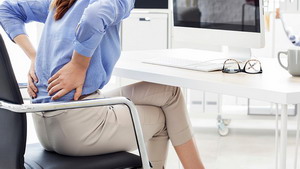 The linked article provides a good review of the many things to consider when picking out a chair to support your back.
“Relationships appear to be necessary for us to learn to be ourselves. It is through our participation with others that we are challenged to discover our truths and learn to live those truths in order to be happy.“
~David DeLapp