|
|
Have you ever awakened in the morning feeling as th ough your body has aged twenty years overnight? Perhaps your knees are stiff, your fingers don’t want to bend, your back feels locked up, or it takes several minutes of moving around before you feel like yourself again.
Morning stiffness is a common complaint, particularly as we get older. But why does it happen, and is there anything you can do to make it better?
The good news is that understanding what is happening inside your body can help you take practical steps toward more comfortable mornings.
Your body has its own lubrication system
Your muscles, tendons, ligaments, and joints are d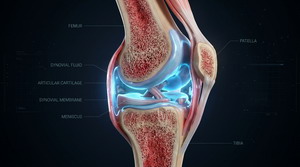 esigned to move smoothly against one another. Several systems work together to make this possible.
Inside movable joints, such as your knees, hips, and fingers, a specialized tissue called the synovial membrane helps produce synovial fluid. This fluid contains substances such as hyaluronic acid and lubricin that help joint surfaces glide with minimal friction.
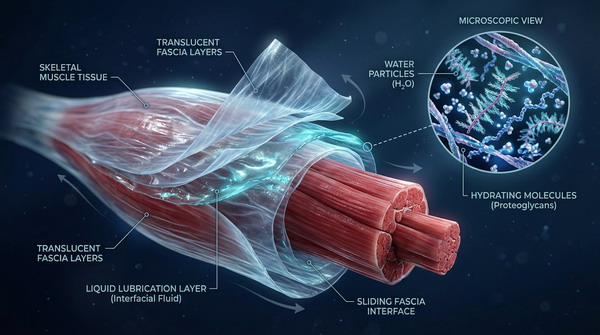 |
Your muscles and tendons have their own lubrication support systems. Layers of connective tissue, often called fascia, surround muscles and help neighboring tissues slide past one another. Water and specialized molecules within these tissues help them remain hydrated and flexible.
Think of your body as having multiple interacting systems that support smooth movement. They include lubrication, tissue hydration, muscle function, and the ability of connective tissues to adapt to movement.
When these systems are affected by inflammation, injury, inactivity, or age-related changes, movement may become less comfortable.
Why Does Stiffness Become More Common as We Age?
Have you ever wondered why a young person can  jump out of bed and immediately start moving, while an older person may need several minutes to get comfortable? Part of the explanation lies in changes to our connective tissues. As we age, the cells responsible for maintaining muscles, tendons, ligaments, and fascia become less responsive to the demands placed upon them. Collagen, the structural protein that gives these tissues strength, can develop additional chemical cross-links through a process called glycation. This is especially likely when blood sugar levels remain elevated over time. These changes can make connective tissues less flexible and reduce their ability to slide smoothly against neighboring tissues.
The good news is that aging does not mean we must accept progressively worsening stiffness. Our connective tiss ues remain living, adaptable structures that respond to how we use them. Regular movement helps maintain joint mobility, while appropriate resistance exercise stimulates tissue maintenance and remodeling. Keeping blood sugar under control may also help limit excessive collagen glycation. In other words, although we cannot stop the aging process, we can influence how well our muscles, joints, and connective tissues function as we get older. Staying active is not just about maintaining muscle strength; it is also about preserving the ability of our tissues to move and slide comfortably against one another.
Why does stiffness seem worse in the morning?
Several factors can contribute.
1. You’ve been still for hours.
During sleep, you may remain in one position for a  prolonged period. Joints and surrounding tissues receive less movement, and muscles are not regularly contracting and relaxing through their normal ranges.
Movement helps distribute joint fluid and supports the exchange of nutrients in cartilage. After hours of relative inactivity, your body may need a little time to get moving comfortably again.
2. Your connective tissues change with age.
Tendons, ligaments, and fascia are living tissues that continually repair and remodel themselves. With aging, changes in collagen structure, tissue elasticity, and the surrounding matrix can make some tissues less adaptable.
This doesn’t mean your body is simply running out of lubricant. Morning stiffness often reflects several factors working together.
3. Inflammation may be contributing.
Inflammation can make tissues sensitive, swollen, an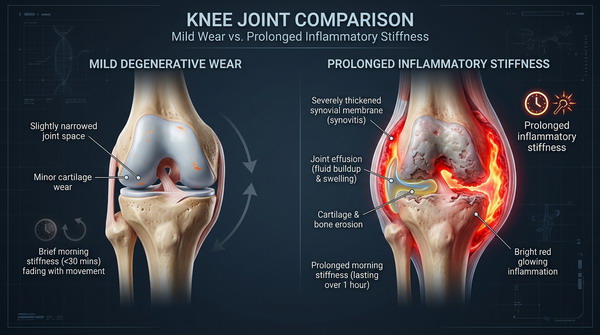 d difficult to move. Osteoarthritis, rheumatoid arthritis, and certain other conditions can all cause stiffness, although they affect the body in different ways.
The pattern matters. Brief stiffness that improves as you move is different from prolonged stiffness accompanied by swollen joints or significant fatigue.
4. Your muscles may be guarding an uncomfortable area.
When a joint or tendon is painful, nearby muscles may tighten to protect it. That protective response can restrict movement and create a cycle of discomfort and stiffness.
The result is that a problem that begins in one structure may affect how the surrounding region moves.
When Old Injuries Leave a Lasting Impression
Have you ever noticed that an area injured years a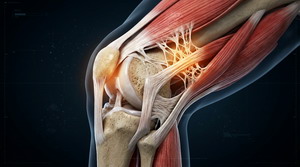 go still feels stiff, tight, or restricted—even when the original injury seems to have healed?
There may be a reason for that.
When you injure a muscle, tendon, ligament, or other soft tissue, your body begins a repair process. As part of that process, it lays down collagen, the structural protein that helps hold tissues together. This is a normal and necessary part of healing.
 |
Imagine the difference between two sheets of fabric that slide easily over one another and two sheets that have become stuck together in places. Both may still move, but the second pair will not glide as freely.
A similar problem can occur when scar tissue or adhesions restrict the movement of muscles, tendons, and fascia. The result may be a feeling of tightness, reduced range of motion, or discomfort when you first begin moving after a period of rest.
This doesn’t happen after every injury, and not all stiffness in a previously injured area is caused by adhesions. Arthritis, persistent inflammation, muscle guarding, and other conditions can produce similar symptoms. Nevertheless, the history of an old injury can be an important clue when evaluating an area that never quite regained its previous freedom of movement.
Can Hands-On Treatment Help?
One approach used by some healthcare practitioners is called instrument-assisted soft tissue manipulation (IASTM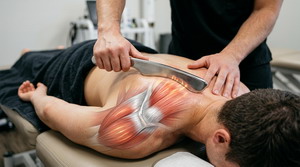 ).
During this treatment, a practitioner uses a specially designed handheld instrument to gently work over selected areas of muscle, tendon, and other connective tissue. The instrument helps the practitioner apply controlled pressure and assess how the tissues respond.
The goal is to improve comfortable movement, reduce sensitivity, and encourage the tissue’s normal remodeling processes. Most patients experience improvements in range of motion and less pain following treatment, although research findings are mixed, and the benefits are not equally well established for every condition.
It is important to understand that the instrument does not simply scrape away scar tissue or mechanically restore lub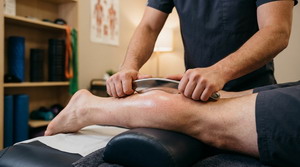 rication. Rather, the treatment is intended to provide a controlled mechanical stimulus to the tissues. Treatment should be selected and performed by a properly trained practitioner after considering the person’s medical history and the nature of the problem. Excessive pressure can cause bruising, irritation, or increased pain, so more aggressive treatment is not necessarily better.
For some patients with persistent soft-tissue restrictions, a combination of appropriate hands-on treatment and gentle movement exercises may help restore more comfortable function.
The goal is not to force the body into submission. It is to help it move more freely, comfortably, and confidently.
Six ways to make mornings more comfortable
 |
You don’t need an elaborate routine or expensive equipment to get started. Small, consistent habits can make a meaningful difference.
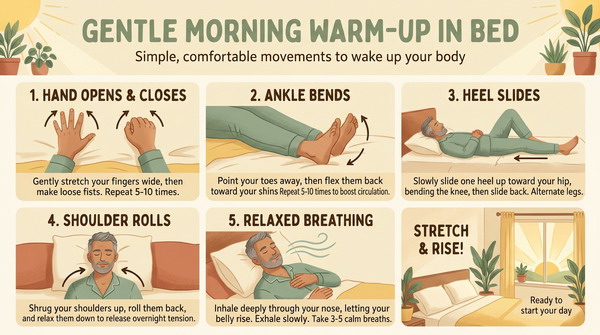
1. Give yourself a gentle warm-up before getting out of bed. Rather than jumping immediately into your morning activities, spend a minute or two moving comfortably.
- Slowly open and close your hands.
- Gently bend and straighten your ankles.
- Slide your heels toward your hips, one leg at a time, if comfortable.
- Make small, comfortable movements with your shoulders.
- Take a few relaxed breaths while allowing your muscles to soften.
The goal is not to stretch as far as possible. It is to remind your body that movement is beginning.
If a movement causes sharp pain, stop or make the movement smaller.
2. Use warmth to help your body relax.
A warm shower can be especially helpful for genera lized stiffness. A warm towel or heating pad may also help a stiff muscle or joint.
Use comfortable warmth rather than intense heat, and protect your skin. People with reduced sensation or circulation problems should take particular care.
If a joint is acutely swollen, hot, or inflamed, avoid assuming that more heat is the answer. That situation may need medical evaluation.
3. Start moving before you start stretching aggressively.
Once you’re up, walk around your home for a few m inutes. Move your arms naturally, take comfortable steps, and gradually increase your range of motion.
Gentle movement often helps reduce stiffness more effectively than immediately forcing a tight joint into a deep stretch.
As your body warms up, you can gradually introduce comfortable mobility exercises appropriate to your needs.
4. Keep your body moving throughout the day.
A morning routine is helpful, but the movement you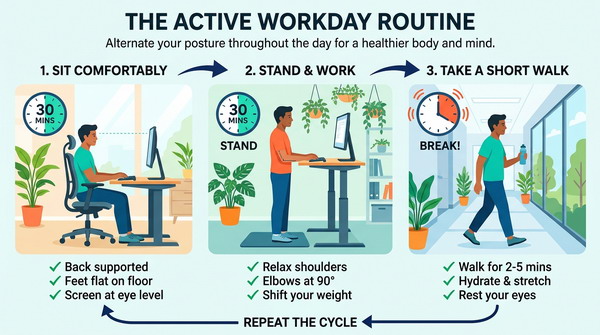 accumulate throughout the day matters, too.
If you sit for long periods, get up periodically and walk for a few minutes. If standing for a long time aggravates your symptoms, alternate between sitting, standing, and gentle movement.
Walking, swimming, cycling, and appropriate strengthening exercises can help maintain muscle function and joint mobility. The best activity is one you can perform consistently without repeatedly aggravating your symptoms.
5. Pay attention to your sleeping position and support.
A position that places prolonged stress on an already 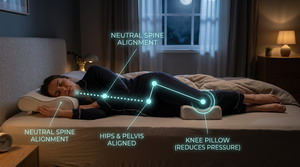 sensitive joint may contribute to morning discomfort.
Try supporting your body with pillows where needed. For example, some people find that a pillow between their knees when sleeping on their side reduces discomfort in the hips or lower back.
There is no single ideal sleeping position for everyone. Experiment with comfortable positions and notice which ones leave you feeling better in the morning.
6. Support your tissues with good daily habits.
Drink enough fluids to maintain normal hydration. E at a balanced diet with adequate protein and a variety of nutrient-rich foods to support muscle and connective-tissue maintenance.
Maintain a healthy level of physical activity, and allow adequate recovery after strenuous exercise.
No particular food, supplement, or amount of water has been shown to reliably eliminate morning stiffness in everyone. The goal is to support the body’s normal repair and maintenance processes rather than search for a single magic ingredient.
When should you have stiffness evaluated?
Morning stiffness is common, but persistent symptom s should not automatically be attributed to aging.
Consider consulting your healthcare professional if stiffness is new, worsening, recurring frequently, or interfering with your normal activities.
Pay particular attention if stiffness lasts more than 30–60 minutes most mornings, especially when accompanied by swollen joints, warmth, or pain in several joints. This pattern can occur with inflammatory conditions such as rheumatoid arthritis and warrants evaluation.
Seek prompt medical attention for a suddenly very painful, hot, or swollen joint, particularly if you also have a fever or feel ill. A joint infection and other urgent conditions must be ruled out.
The location, duration, severity, and associated symptoms help determine whether the problem is related to osteoarthritis, muscle or tendon problems, an inflammatory condition, or something else.
A final thought: Movement is part of maintenance.
Your body is not a machine that simply wears out with
 use. It is a living system that responds to how you use it.
Connective tissues adapt to appropriate movement and loading. Muscles maintain their capacity through activity. Joints benefit from regular movement within comfortable limits.
If you wake up stiff tomorrow morning, try a simple experiment: begin with gentle movements, apply a little warmth if appropriate, and gradually get moving instead of expecting your body to perform at full capacity the moment you open your eyes.
You may find that a few minutes of thoughtful movement make the transition into your day considerably easier.

The goal isn’t to eliminate every sensation of stiffness. It’s to help your body move comfortably, preserve your independence, and keep doing the activities that make life enjoyable.
Ellen
It is Halloween time! This morning chatGPT sent me  an email offering to turn a picture of my family into a Halloween portrait. I thought that would be fun to do with Ellen, so I downloaded a picture of her and hit the button. Well this picture popped up along with some random guy and a dog with a bat suit on. I asked chat to eliminate the dog and random guy and this lovely portrait showed up.
Smiling boosts your health Smiling is shown to reduce your cortisol levels (the st ___________________________ “We must embrace the unknown because reflections of the unknown parts of ourselves exist out there amongst the unknowns. We must suffer the discomfort of the unknown to discover the unowned parts of ourselves. “
~David DeLapp _____________________________________ Plastic tea bags are nasty Tea bags made from a plastic mesh dump endrocrine ____________________________ “The day to day purpose of life is to feel our heart’s desires and develop effective harmonious skills to achieve them. Why? Because this is how we learn respect for others.“ ~David DeLapp ________________________________________ New nasal spray psychedelic relieves depression It has been known for many years that various psyc “Poor fortune or bad luck is certainly a bitch, and ultimately she always wins. No one beats entropy in the long run. But the existence of life is the struggle against entropy. We shine for a brief period of time by defying the natural laws of the universe. So in essence hope is irrelevant. None of us are going to win. Death takes us all. However, our glory is in our fight until that time. Do we shine in our defiance of the natural order, or do we give in to it? Which feels better to us? That is the personal choice. “ ~David DeLapp
|