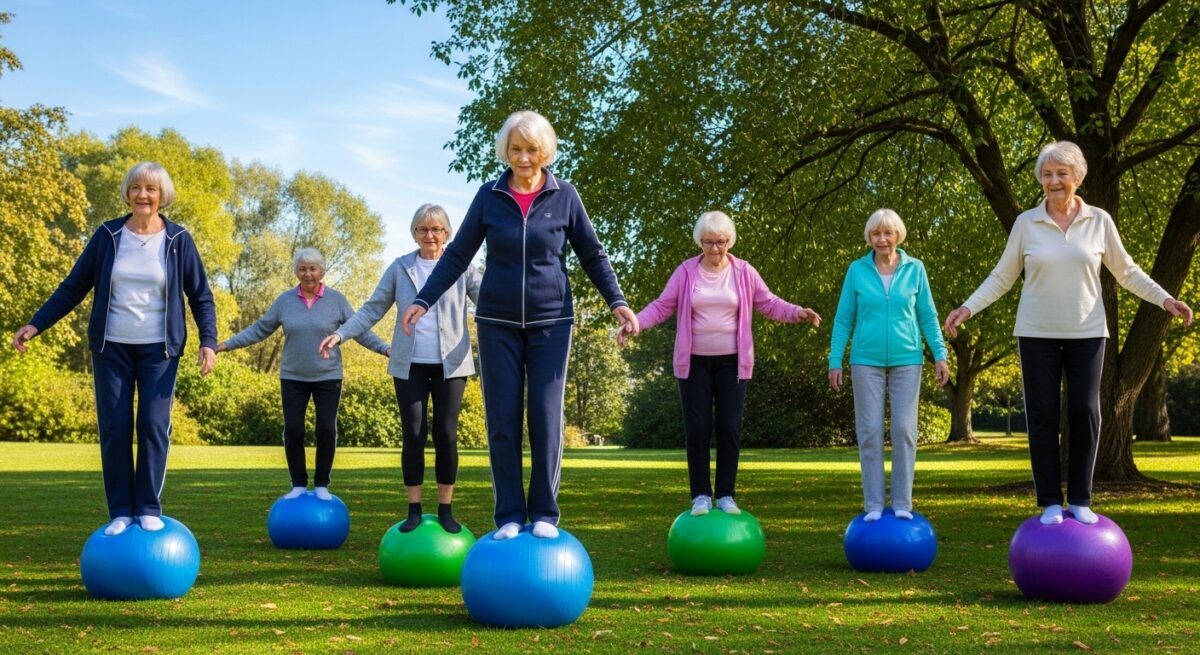
I have had several patients over the last week that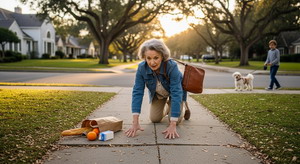 have come in due to injuries caused by a fall. Falls are one of the most serious health risks for older adults. Each year, one in four Americans over the age of 65 experiences a fall — and the consequences can range from bruises and lost confidence to broken bones and long hospital stays. The good news is that balance is a skill, and like any skill, it can be tested, trained, and improved at almost any age.
I will explain two simple, clinically proven tests you can use to measure your balance, and offer practical exercises you can start right away to build strength and stability.
Why balance matters
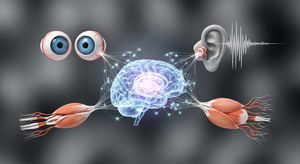 Balance is not one single ability — it is a team effort. Your eyes, your inner ear, and the nerve receptors in your muscles and joints all send constant signals to your brain, which then coordinates your muscles to keep you upright. As we get older, each of these systems can slow down or lose precision. Leg muscles weaken, reaction times increase, and inner ear function may decline. The result is that the small, automatic adjustments we make dozens of times per minute when standing or walking become less reliable.
The encouraging news is that the body responds to 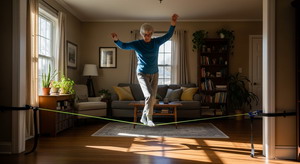 balance training at any age. Research shows that targeted exercise can reduce the risk of falling by 20 to 40 percent in older adults — a bigger impact than most medications prescribed for fall prevention.
Balance Tests
We use a variety of tests to measure balance, but the two main ones we use for fall-risk screening are:
The 30-Second Sit-to-Stand Test
This test measures the strength and endurance of your leg muscles, which are the engine behind safe movement. Here is how it works:
- Sit in an ordinary chair (seat height about 17 inches) placed against a wall.
- Cross your arms over your chest — no using your hands to push off.
- On the count of “go,” stand up fully and sit back down as many times as you can in 30 seconds.
- Your score is the number of complete stands you complete.
A healthy woman aged 70 to 74 would typically complete 12 to 16 stands; a man of the same age might manage 13 to 17. Scores below the expected range suggest that leg strength needs attention and that fall risk may be elevated. The test is also excellent for tracking progress — if you repeat it after 8 to 12 weeks of exercise, improvement in your score is a concrete sign your training is working.
The 4-Stage Balance Test
Where the sit-to-stand test challenges your strength in motion, the 4-Stage Balance Test focuses on your ability to ho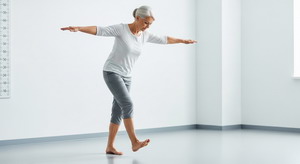 ld a steady position — what clinicians call static balance. The four stages are performed in order, each held for 10 seconds:
- Stage 1 — Feet together: Stand with your feet side by side.
- Stage 2 — Semi-tandem: Place the heel of one foot beside the big toe of the other foot.
- Stage 3 — Full tandem: Place one foot directly in front of the other, heel to toe, as if standing on a tightrope.
- Stage 4 — Single-leg stand: Lift one foot off the ground entirely.
You move on to the next stage only if you successfully hold the current one for the full 10 seconds. The critical marker is Stage 3: research has consistently found that people who cannot hold the full tandem position for 10 seconds face a significantly higher risk of falling. Successfully completing all four stages, especially the single-leg stand, indicates strong postural control.
You can do these tests at home to evaluate your current balance skill. If you find you are lacking then balance exercises are your next step.
Exercises to Improve Your Balance
Whether your test results revealed room for improvement or you simply want to stay ahead of the curve, the following exercises address both static balance (staying steady in one position) and dynamic balance (staying steady while moving). Aim to practice two to three times per week, always near a counter or sturdy chair for safety.
Build Your Static Balance
Work through these in order as you gain confidenc e. Each should be held for 10 seconds and repeated 3 to 5 times on each side:
- Feet together, eyes open — the starting point for most people.
- Semi-tandem stance — one heel beside the other foot’s big toe.
- Full tandem stance — heel directly in front of toe, as in Stage 3 above.
- Single-leg stand — lift one foot just off the floor; work up to 30 seconds.
- Progress further by performing any of the above with eyes closed or on a folded towel for a softer, less stable surface.
Add Dynamic Balance Training
Static balance is the foundation, but real-world falls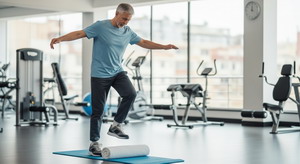 almost always happen during movement. These exercises train your ability to stay stable while you are in motion:
- Heel-to-toe walking: Walk along a hallway placing each foot directly in front of the other, heel to toe, for 20 steps.
- Lateral stepping: Step sideways across the room, leading with one foot and bringing the other to meet it, 10 to 15 steps each direction.
- Stepping over obstacles: Place a small book or rolled towel on the floor and practice stepping over it, focusing on lifting your foot high and controlling your landing.
- Walking with head turns: Walk at a normal pace while turning your head to look left and right alternately. This challenges your vestibular (inner ear) system — the same system challenged when you look around in a busy environment.
- Sit-to-stand repetitions: Rise from a chair without using your hands, 10 times in a row. This builds the strength that supports everything else.
Strengthen the Supporting Muscles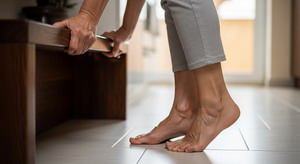
Strong ankles, hips, and core make every balance task easier. Two of the most practical exercises are calf raises — simply rising onto your toes while holding a counter, then lowering slowly — and the “bird dog,” which involves kneeling on all fours and extending one arm and the opposite leg simultaneously, then holding for a few seconds before switching sides. Both can be done at home with no equipment.
If you want to engage a much more serious and rigorous balance program, The Otago balance program developed in New Zealand is about the best I have seen. Here is a link to their work manual. https://www.livestronger.org.nz/assets/Uploads/acc1162-otago-exercise-manual.pdf
The part you would want to zero in on are the pages 34 to 71.
Try Tai Chi: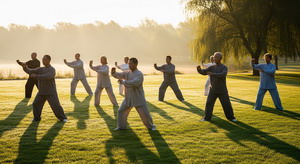
If you enjoy a more structured, social approach, Tai Chi is one of the most thoroughly researched interventions for fall prevention in older adults. Its slow, flowing movements and wide, low stances train both static and dynamic balance simultaneously, and classes are widely available through senior centers and YMCAs.
If you find that you cannot hold Stage 3 of the 4-Sta ge Balance Test for 10 seconds, or that you are scoring below average on the sit-to-stand test, it is worth mentioning at your next appointment. I can identify the specific weak links in your balance system — whether that is leg strength, ankle flexibility, vestibular function, or something else — and design a program tailored precisely to your needs.
Balance problems can also sometimes be linked to medications, inner ear conditions, vision changes, or neurological issues, all of which a physician can evaluate. Addressing those underlying causes can make a significant difference alongside exercise.
The Bottom Line
Good balance does not have to decline with age. Sim ple tests can tell you where you stand today, and consistent, targeted exercise can meaningfully reduce your risk of falling. Even small improvements — holding a tandem stance a few seconds longer, standing up from a chair a little more easily — add up to greater safety, confidence, and independence over time. Start where you are, progress gradually, and do not hesitate to ask for professional guidance.
Take care,
David
Ellen
Exciting occasion! Today Ellen took her first 2 steps s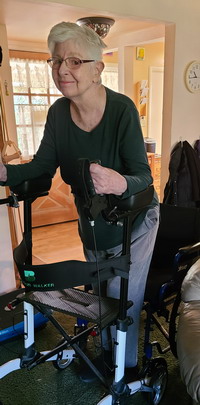 ince Christmas! We have been working on increasing her ability to get up and down from the edge of the bed and swinging into her wheel chair, and most recently to her commode. But today we had her stand up and hold on to her upright walker and take two steps forward. We need to focus on the muscles that lift her legs up so she can take more steps.
Caffeine appears to lower dementia risk
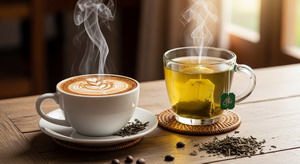
Reviewing the data from a couple huge studies of folks over 43 years has shown that drinking coffee, tea, of caffeinated beverages lowers dementia risk by 14% to 22%.
___________________________
~David DeLapp
_____________________________________

An amazing biological circuit was discovered for preventing allergies. While you are having a lung reaction to a virus or bacteria, your system blocks reactions to allergens you are exposed to. This blockage can last several months, long after the lung infection is gone.
____________________________
“Chance favors the prepared mind. Life is filled with random opportunity. The more you know, seek, and engage, the more you can create what you want.“
~David DeLapp
________________________________________
Psilocybin and MDMA psychedelics repair brain cells to reduce anxiety and PTSD
Detailed research is showing that certain psychedelic drugs repair and remodel the myelin sheath around the ner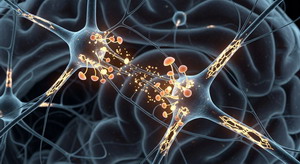 ve cells to reestablish harmony in the brain.
________________________
“Life is a mirror of us. Our attention is drawn to reflections of ourselves. Attraction or negative judgments are reflections of our feelings of ourselves. What we see outside ourselves is only a reflection of how we experience ourselves on a feeling level inside. “
~David DeLapp