When we think about healthy aging, we often think about cholesterol, blood pressure, blood sugar, and body wei ght.
ght.
There is another factor that deserves much more attention:
How much muscle do you have, and how well does it work?
Muscle is not simply something that helps us lift things and climb stairs. It is one of the body’s most important metabolic organs. Your muscles are major consumers of glucose. Every time your muscles contract, they use energy and take glucose out of the bloodstream.
That means maintaining healthy muscle becomes increasingly important as we age.
Why does muscle become harder to maintain?
Throughout life, your muscles are constantly being r emodeled. Old proteins are broken down and replaced with new ones.
Two things are especially important in this process:
Exercise tells the muscle to build and adapt.
Protein supplies the raw materials.
Unfortunately, aging can make the muscle somewhat less responsive to these signals.
Researchers call this anabolic resistance.
It doesn’t mean that older people cannot build muscle.
It means that the protein signal required to stimulate muscle rebuilding needs to be stronger. What is that signal – the amino acid methionine.
Protein becomes more important—not less.
Research in older adults suggests that many people benefit from consuming more protein than the minimum amount traditionally recommended.
One reason is that a larger protein dose may provide a stronger signal to older muscle. In fact a 65 year-old person needs twice as much protein to trigger a muscle building response as a 30 year old.
Protein quality matters, too.
The essential amino acids leucine and methionine are particularly important because they help activate the cellular machinery responsible for muscle protein production.
This is one reason high-quality proteins such as dairy, eggs, fish, meat, and soy can be useful. People who obtain most of their protein from plant foods can also meet their needs, but may need to pay more attention to total protein and the amino-acid composition of their meals.
But protein doesn’t build muscle by itself.
This is perhaps the most important point. Eating protein doesn’t tell your body that it needs more muscle. Using your
 muscles does.
Resistance exercise provides the signal. Protein provides the building materials.
The two work together.
This is why simply increasing protein while remaining sedentary is not an adequate strategy for preventing age-related muscle loss.
You don’t have to become a bodybuilder.
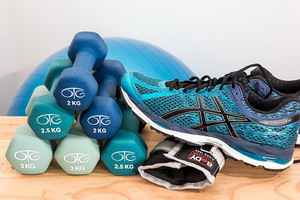
Resistance exercise doesn’t necessarily mean joining a gym. A resistance exercise can be as simple as:
- standing up from a chair repeatedly
- doing supported squats
- pushing against a wall
- performing heel raises
- using resistance bands
- lifting light weights
- carrying groceries
The goal is to give your muscles a reason to remain strong.
And there is an important psychological point here.
If you haven’t exercised for years, being told to start a sophisticated exercise program can be overwhelming.
You don’t need to start there.
You need to start somewhere.
Small beginnings count.
A person who currently spends most of the day sitting may begin with something as simple as standing up several time s throughout the day.
Then perhaps a few chair stands.
Then a short walk.
Then a longer walk.
Then some resistance exercises.
The goal is not to transform yourself overnight. The goal is to create a gradual progression in which today’s activity makes tomorrow’s activity possible.
This approach may be particularly important for older adults because strength, balance, joint comfort, and cardiovascular fitness can all limit where we begin.
For healthy aging, I like to think about muscle this  way:
way:
Give it a reason to grow or remain strong.
→ Resistance exercise
Give it the materials it needs.
→ Adequate protein
Give it time to recover.
→ Sleep, rest, and periods without eating
We don’t need to maximize all three every hour of every day. We need to create a pattern that works repeatedly.
And muscle is only half of the metabolic story.
The other half is what happens to the fat that accumulates around the organs as we age. That brings us to visceral fat—and why simply losing weight isn’t necessarily the best way to think about metabolic health. Part 2 next week!
Take care,
Colloidal Silver is back and available in the office. Silver has quadrupled in price over the last two years, so the price we have it for in the office is a real steal!
While Ellen was in the skilled nursing facility her dental hygienist, Nahed, came to visit and brought Ellen a lovely get well gift. Nahed is actually a dental surgeon back in Egypt, but here in America she decided to be a hygienist at Dr Mohamed’s office. Ellen has a wonderful relationship with her dentists, since Ellen spent 30 years in the dental field managing dental offices. She really likes Dr. Mohamed’s office, and they like her.
Non-surgical approaches to chronic low back pain
There are many things you can do yourself to he lp calm down lower back pain. This article covers many of those choices available to you.
More
___________________________
“A general tone of happiness comes from appreciating the skills we have developed; from knowing that we are good enough. We accept that there will always be new problems and challenges, but overall we are good enough.“
~David DeLapp
_____________________________________
Keeping seniors independent
Keeping seniors independent is a major challenge. E xercise is the biggest support for healthy aging and brain health. The linked article discusses several further important steps helpful in building independence.
More
____________________________
“The problem we are always trying to solve is how to have both peace and joy. This is an inside-out process. We are not here to change others or the world, but by being us we may inspire change.“
~David DeLapp
________________________________________
Preventing loss of physical function as you age
This article focuses on the basics – strength, mobility, coordination, and balance. A good well thought out piece on how to age well.
More
________________________
“We are problem solving creatures. Comfort is the very temporary feeling that we have solved some discomfort producing problem; then we are on to the next problem.“
~David DeLapp