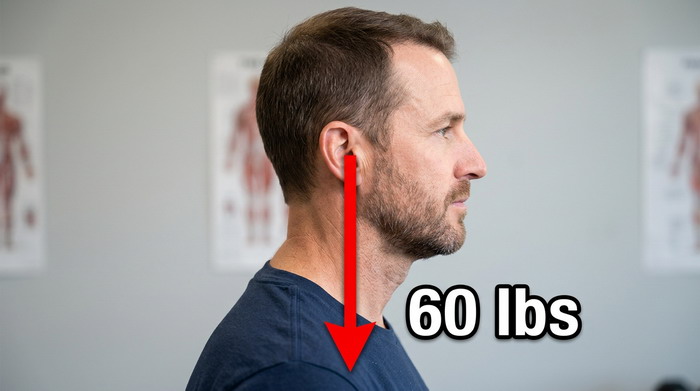
Most of us have heard that “tech neck” or forward  head posture isn’t great for us. But did you know it could be connected to symptoms far beyond neck pain — including digestive problems, anxiety, heart palpitations, dizziness, and even brain fog? The key link is a remarkable nerve called the vagus nerve — and understanding it may help explain why so many of your symptoms seem mysteriously connected.
What Is the Vagus Nerve?
The vagus nerve is the longest nerve in your body
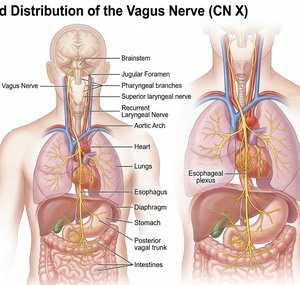 — it wanders from your brainstem all the way down through your neck, chest, and abdomen, connecting your brain to your heart, lungs, stomach, intestines, and more. Think of it as your body’s internal communication superhighway.
Its main jobs include:
Regulating your heart rate and blood pressure
Controlling digestion and gut function
Managing your breathing
Calming your body after stress (the “rest and digest” response)
Helping you swallow, speak, and hear properly
Reducing inflammation throughout the body
When the vagus nerve is working well, you feel calm,  balanced, and healthy. When it is irritated, compressed, or not firing properly, the effects can ripple across your entire body — often in ways that seem totally unrelated.
Where Does Forward Head Posture Come In?
Forward head posture (FHP) — that position where yo ur head juts forward rather than sitting directly over your shoulders — is increasingly common thanks to hours spent on phones, computers, and tablets. It might look like a minor posture problem, but the effects run deeper than most people realize.
Here’s why it matters: The vagus nerve travels thr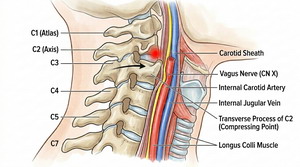 ough the neck in a protected bundle called the carotid sheath, running very close to the top vertebrae of the spine (C1–C3). When your head shifts forward, it places significant mechanical stress on this area, stretching and compressing the structures inside — including the vagus nerve.
To put this in perspective: for every inch your head m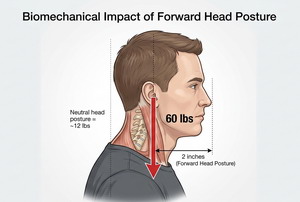 oves forward, the effective weight your neck must support roughly doubles. A head that weighs 10–12 pounds in a neutral position can feel like 40–60 pounds when held two inches forward. This chronic mechanical load gradually damages the ligaments that hold your vertebrae in place, causing what researchers call cervical instability.
What Happens to Your Neck Curve Over Time
Normal: Head balanced over shoulders, healthy cervical curve, nerves and blood vessels are relaxed.
Mild FHP: Head begins to drift forward; nerves and blo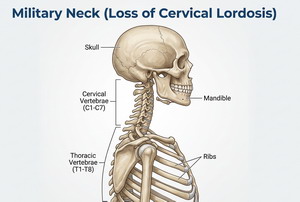 od vessels begin to stretch.
Military Neck: Cervical curve flattens (“straight neck”); the spine loses its natural shock-absorbing ability.
Kyphosis: The curve reverses entirely — nerves, blood vessels, and the vagus nerve are under severe, constant mechanical stress.
What Is Cervical Instability — and Why Does It Matter?
Cervical instability means the ligaments that normally  hold your neck vertebrae securely in place have become weakened or damaged. This can happen gradually from chronic poor posture, or more suddenly from an injury like whiplash, a concussion, or complications from neck surgery.
When these vertebrae are no longer properly anchored, they can shift or “wander” — and when they do, they can press on or stretch the vagus nerve and related nerve structures nearby. Researchers use the term cervicovagopathy to describe what happens when neck instability causes vagus nerve dysfunction.
This matters enormously because the vagus nerve supplies nearly every major organ from the neck down. Even mild, chronic compression can impair how nerve signals travel — leading to a cascade of symptoms throughout the body.
The Wide-Ranging Symptoms of Vagus Ne rve Irritation
Patients whose vagus nerve is irritated or compressed often present with symptoms that seem completely unrelated to the neck. This is why they frequently end up seeing multiple specialists — a cardiologist for heart palpitations, a gastroenterologist for digestive issues, an ENT for swallowing problems — without anyone connecting the dots.
Symptoms can include:
- Anxiety, depression, and mood changes
- Brain fog and difficulty concentrating
- Heart palpitations or an unusually fast heart rate
- Dizziness or lightheadedness
- Bloating, nausea, and digestive problems (including GERD, constipation, or gastroparesis)
- Difficulty swallowing or a chronic cough
- Tinnitus (ringing in the ears)
- Headaches or migraines
- Fatigue and low energy
- Shortness of breath
- Urinary problems
- Poor stress tolerance
One helpful clue: if turning your head or making facial movements like chewing, laughing, or speaking triggers any of these symptoms — that strongly suggests a neck-related cause.
Why Forward Head Posture Is Especially Damaging
Chronic forward head posture does not just strain mus cles — it causes structural changes in the neck over time. The muscles in the front of the neck (called the longus capitis and longus colli) become extremely tight in this position, further compressing the surrounding nerve and vascular structures. Meanwhile, the ligaments that should be supporting your vertebrae are constantly overstretched and eventually weaken. Here is a simple head forward posture test.
As the vagus nerve is the longest nerve in the body, i t is especially vulnerable to being “stuck” or compressed when the neck’s musculoskeletal structure changes. Over time, sustained compression does not just irritate the nerve — it can cause actual nerve damage, progressing from temporary irritation to inflammation, and eventually to neuron (nerve cell) death.
What Can Be Done About It?
The good news is that when the underlying structur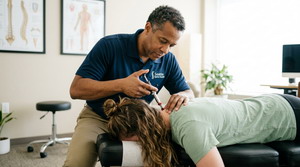 al problem in the neck is addressed, vagus nerve function can often be improved. Treatment approaches may include:
- Postural retraining and rehabilitation exercises to reduce forward head posture Check these links to rehabilitative exercises: Link 1, Link 2, Link 3
- Cervical curve correction therapies to restore the natural lordotic (inward) curve of the neck
- Prolotherapy — an injection-based treatment designed to stimulate healing in weakened cervical ligaments
- Chiropractic adjustments to address vertebral misalignment
- Vagus nerve stimulation techniques (breathing exercises, humming, cold water to the face) to improve nerve tone while structural issues are being addressed
Diagnosing the problem accurately is the critical first step. Advanced imaging, including upright or dynamic X-r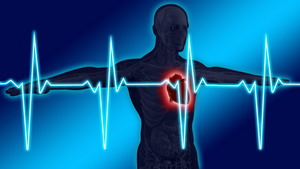 ays and high-resolution MRI, can reveal structural changes in the cervical spine that standard scans often miss. However much simpler findings can clue us in to vagus nerve issues. For instance, heart rate variability (HRV) testing gives insight into how well your vagus nerve is actually functioning. Decreased HRV is typically a sign of vagus dysfunction. HRV apps are readily available for your cell phone.
Other Signs That Your Vagus Nerve May Be Struggling
Talk to your healthcare provider if you notice:
- A resting heart rate consistently above 100 beats per minute
- Your uvula (the tissue hanging at the back of your thr
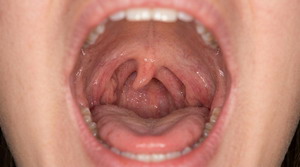 oat) visibly deviating to one side
- One pupil noticeably larger than the other, along with light sensitivity
- A reduced or absent gag reflex
- Slowing your breathing does not slow your heart rate
The Bottom Line
Your posture is not just about how you look. The for ward head position many of us default to during daily screen time can, over months and years, contribute to real structural changes in the neck that compromise the vagus nerve — your body’s most important calming, healing, and regulatory nerve. If you have a long list of seemingly unrelated symptoms and persistent neck issues, this connection is worth exploring with your healthcare provider.
Take care,
David
Our GP has referred Ellen to a specialist who knows what to do with these types of hip problems. We have not been contacted by the specialist yet, so we are waiting. My suspicion is t hat we are looking at a hip replacement surgery. In the meantime life moves forward the same as usual.
|
|
Vitamin C for 200 diseases
Vitamin C is for a lot more than just preventing scur vy. It is necessary for our body to produce collagen, the protein that holds everything together. In particular it is a major player in preventing strokes and cardiovascular prolems vy. It is necessary for our body to produce collagen, the protein that holds everything together. In particular it is a major player in preventing strokes and cardiovascular prolems
More
___________________________
“To love is to happily embrace and participate with what is. Love respects and appreciates things and people as they are, not as we want them to be.“
~David DeLapp
_____________________________________
Vagus nerve reset
The linked article gives you a nice review of a numbe r of different ways to reset the vagus nerve. A well functioning vagus is probably the most important thing you can do to improve your health overall. r of different ways to reset the vagus nerve. A well functioning vagus is probably the most important thing you can do to improve your health overall.
More
____________________________
“Effectiveness is the measure of truth. All systems, beliefs, and organizations are made up. To determine if something truly works we must judge the tree by its fruits. What outcomes result from the application of these beliefs on all levels? “
~David DeLapp
________________________________________
High dose nattokinase reverses heart disease
I a study of over 1000 patients with heart disease, taking 10,800 FU of nattokinase daily showed 65% to 95% reductio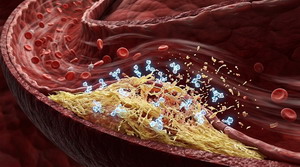 n of atherosclerotic plaques and decreased thickening of the carotid artery. Taking only 3600 FU per day showed no help. This is what I have been taking daily for many months now. n of atherosclerotic plaques and decreased thickening of the carotid artery. Taking only 3600 FU per day showed no help. This is what I have been taking daily for many months now.
More
________________________
“The power of now. There is only this now moment. All action and all feeling only exist in this now moment. The past is gone and the future doesn’t exist yet.“
~David DeLapp
|