Over the last several years, I have extolled the vir tues of extra slow weight lifting. This method of lifting protects your joints while building muscle faster than the typical rapid up-and-down lifts. The process enables you to use lighter weights to achieve the same strength rewards. With lighter weights, the chances of you injuring a muscle or tendon go way down, thus making the lifting safer and better for older patients. This process builds strength. However, there are other concerns to consider.
I read a recent article on Medical Express that highlighted a completely different aspect of aging muscles that n eeds to be considered – power. Power is about how fast your muscles can produce a force. This becomes particularly important for maintaining your balance. If you start to slip or fall, you need instant power in your muscles to respond and protect yourself. Unfortunately, power fades faster than strength does as we age.
What is this all about on a physiological level? Basically, we have two types of muscle cells – fast and slow. The fast-twi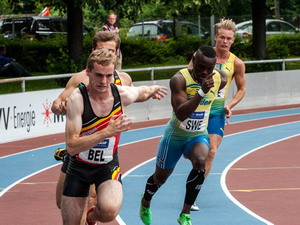 tch muscle fibers are the ones that jump into action immediately to respond to a sudden need. The slow-twitch muscle fibers provide the strength and stamina to get the heavy work done, but they do not jump into action as quickly as the fast-twitch muscles do. Think of a sprinter in a track meet. His or her body probably has a larger percentage of fast-twitch muscle fibers compared to a long-distance runner. The long-distance runner possesses more slow-twitch muscle fibers. Although they lack the speed required for a 100-yard dash, their muscles endure throughout a marathon.
Well, the slow eccentric muscle technique I was teac hing previously trains your slow-twitch muscle fibers. But for good balance and coordination, we need the fast fibers, and these are the ones that tend to shrink and weaken quickly with age. When researchers look at folks that have fallen recently, they find that those that had fallen had less power in their legs, even though they had plenty of strength. Low leg power predicts decreased mobility as you age.
Would you like to test this on yourself? The simple sit-to-stand test is what we use in the office. There are a couple o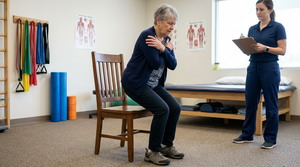 f variations on this test, so I will give you the easiest. The test is to see how many seconds it takes you to go from a sitting position to a full standing position five times. Having somebody time you with a stopwatch is easiest, but you can time yourself if you are coordinated enough. The proper position is to have your hands crossed over your chest and holding the opposite shoulder. No arm swinging to help you get up. Adults under 60 usually finish in under 10 seconds. For those over 60, times over 15 seconds indicate functional weakness and an increased risk of falls.
What is the takeaway from this information? We nee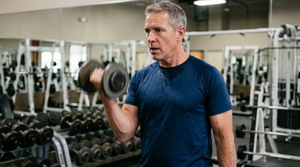 d to speed train as well as strength train. What does that look like for me when I go to the gym? Now when I go to do a particular lift, I do a rapid power lift up and down five times and then do my usual rapid contraction with the slow extension taking 12 to 15 seconds for the eccentric phase of the lift. I do this until I reach exhaustion. At this point, I immediately start my next (different) exercise or lift – no rest between lifts.
The article on power lifting was just one of several exercise-related news tidbits I came across this last week. Anot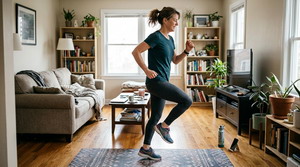 her gem is research I came across 20 years ago on just how little exercise you need to generate a significant impact on your health. In the world of science, initial findings have to be replicated many times in many different circumstances over many years before a consensus is reached among the scientific community. Well, it looks like a consensus has been reached on what minimum level of exercise we all need. The word is that we need an all-out effort doing something for about 30 – 60 seconds four times a day every other day. That is not a lot of time. It does require maximum effort, however. I might be running, cycling, climbing, swimming, whatever. The point is to push yourself to your limit.
I was discussing some of this exercise stuff with my so n Devon, when he started telling me about what he has been learning from his trainer at the gym about functional exercise. What that is all about is what we used to call compound movements. Most exercise in a gym environment is focused on one primary muscle group at a time. The exercises are rather artificial and not the kind of muscle activity we encounter in everyday life. In our real world, we use our muscles as complex combinations of activity in order to get real-world things done. When you want to move that heavy bag of dog food from the trunk of your car into the garage, you are wrestling with that bag from many angles, trying to walk without dropping it, and then trying to jockey it into position where you want it in the garage.
My son’s example was the type of strength and balan ce needed to drag an eleven-year-old boy up out of bed in the morning to get him ready for school. Apparently, this is a functional workout every morning.
Functional movement is basically broken down into s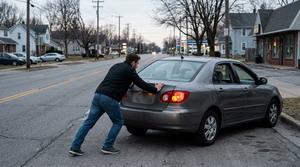 even fundamental moves. Here is a simple video demonstrating these 7 movements:You can see from this video that we are talking about using multiple muscles at a time in order to do things functionally around the house. If you do a search for functional mobility exercises, you will get a ton of exercise options.
The last hot trend in exercise science I came across t his last week is training your tendons and ligaments. This is the trendy way of describing a strengthening technique I used to read about in the back of my comic books when I was a kid. This is the old Charles Atlas method of strength training known as isometric exercise. With isometric training, you are not moving at all. For folks with limited mobility, this is a huge benefit. It works well for everyone, but the ability to exercise without moving takes away the limitation folks with injured joints and other impediments to movement have to exercise. Video
The concept is simple. Find a position that enables you to push or pull / extend or contract your muscles against resi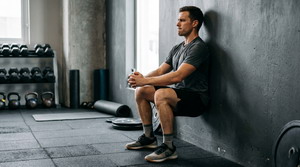 stance stronger than you can move. You apply your strength against this resistance for 10 to 30 seconds as much as you can, then rest for 30 seconds. Do this several times for each muscle you can engage in this way. A popular one I have been seeing lately is to back up to a wall, slide down into a 90-degree squat – like you are sitting in a chair except there is no chair – and hold that position for up to 2 minutes. This really engages your glute muscles as well as your calf muscles. They say that this can reduce your blood pressure if that is a problem for you. That seems believable to me as your calf muscles act like a second heart to move blood and fluid up out of your legs.
As you can see, the last couple of weeks have been f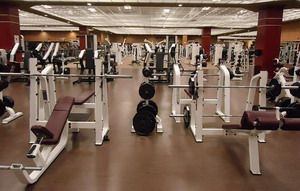 ull of exercise advice offered by all sorts of experts. So what is my take on all this information? Basically, you’ve got to move! You have got to work those muscles if you want them to work for you. Variety is more than just the spice of life. With movement, we need all sorts of variety. I fall into the bad habit of working out the same old way when I go to the gym. Habits make life easier. Easy is bad for muscles. They rot away when we fall into the easy way of doing things. The good news is that it does not take a lot of time out of the week to make the muscles happy and functional. A couple of hours a week of doing a variety of things will keep them working for us in the long run. And I guess that is just what we need, the strength for the long run.
Take care,
David
Ellen
Most of the ladies I know always like a new pair of shoes. Ellen is no exception. She decided that she wanted a pair of Muk 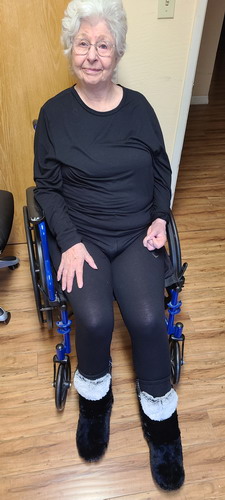 Luks like she had as a young girl. Well Amazon has tons of stuff, including a couple dozen types of Muk Luks. A brief pursual of the selection and Ellen chose this cute pair. They look nice, but the left foot is too tight due to the swelling in her left leg, so I will probably be sending this pair back.
|
|
| Too much sitting increases death
While not exactly news, newer studies are showin g that, particularly in folks with diabetes, too much sitting increases all cause mortality. Getting that 150 minutes a week of moderate to vigorous exercise erases that increased risk of an early death. Sitting for eight or more hours per day gave folks a 73% increased chance of an early death.
More
___________________________
“You are not wanted for who you are, you are wanted for how well you play the game of life with others. Your outflow determines your inflow, or said another way, how well you shine determines how others will treat you.“~David DeLapp
_____________________________________
Getting into ketosis faster
The fat burning state in the body is called ketosis,  because as the body recruits fat for energy, it first turns that fat into ketones, which the body can burn just like sugar. This article lists 7 helps for getting into ketosis faster. Though one of their statements misses the mark where they say you just need to consume a max of 50 grams of carb a day. For most people getting into ketosis that number is 20 grams.
More
____________________________
“Connection occurs in the communication around the sharing of a common focus of attention. If you have no interest in what others are focused on, the chances are you won’t make much of a connection with them.“
~David DeLapp
________________________________________
Benefits of High Intensity Interval Training
HIIT offers many benefits, such as taking much le ss time, increased fat burning, improved heart health, improved mental health and cognition.
More
________________________
“Love respects the autonomy of others. Fear suppresses the autonomy of others. “
~David DeLapp
|
|