
What if trust weren’t about deciding who is good or bad, but about learning to see people more clearly — and choosing how we wish to engage with them?
Trust is one of the most important elements of our relationships. We want  to trust our partners, our families, our friends, our coworkers, and the people who care for us. When that trust is shaken, we may feel disappointed, betrayed, angry, or afraid. We may begin to question the other person’s character—or even our own judgment.
But what if we approached trust from a different perspective?
Instead of asking, “Can I trust this person?” we might ask, “What have I learned about this person, and how can I use that understanding to make wiser choices?”
This seemingly small change in perspective can make a significant difference in how we experience our relationships and how we respond when others disappoint us.
Trust Is Not the Same as Approval
We often divide people into two categories: those who can be trusted and those who cannot. We may assume that a trustworthy person will do what is right, while an unt rustworthy person will do what is wrong.
The difficulty is that we don’t all share the same understanding of what is right. People have different values, priorities, fears, expectations, and ways of interpreting the world. What seems obvious or reasonable to us may look entirely different to someone else.
Consider a friend who repeatedly cancels plans at the last minute. You might interpret this as disrespect or a sign  that the friendship doesn’t matter to them. Those interpretations are understandable, but they are not the only possibilities. Perhaps your friend struggles with organization, has difficulty saying no, or simply places a different priority on keeping appointments.
Understanding the reason doesn’t mean you must approve of the behavior. Nor does it mean you must continue making plans that leave you frustrated.
It simply allows you to distinguish between understanding someone and judging them.
You might conclude, “This person is not dependable when it comes to appointments, so I’ll make plans differently.” That conclusion may serve you better than repeatedly expecting the person to change, feeling hurt when they don’t, and wondering what their behavior says about your worth.
Trust can become less about deciding whether someone is good or bad and more about understanding what you can reasonably expect from them.
When Expectations Become a Source of Suffering
Much of our disappointment comes from the gap between what we expect people to do and what they actually do.
We may believe that a loving partner should understand  our needs without being told. We may expect family members to reciprocate our generosity. We may assume that if we treat others with honesty and consideration, they will treat us the same way.
These expectations are understandable. Many reflect values that are important to us. But they are not guarantees about how other people will behave.
When someone fails to meet an expectation, we often move quickly from observing what happened to deciding what it means.
“My friend didn’t call” becomes “My friend doesn’t care about me.”
“My partner disagreed with me” becomes “My partner doesn’t respect me.”
“My family member didn’t help me” becomes “My family member has betrayed me.”
Sometimes these conclusions are accurate. Sometimes they are incomplete. And sometimes they reflect assumptions that have never been examined.
The important distinction is that what happened and what we believe it means are not necessarily the same thing.
Learning to recognize that distinction doesn’t require us to dismiss our feelings. Our feelings are real, and they can provide valuable information. But feelings alone cannot always tell us whether our interpretation is accurate.
We can respect our feelings while remaining curious about what produced them.
Questions That Can Change Your Perspective
When a relationship leaves you feeling hurt, angry,  or uncertain, try pausing before deciding what the experience means. A few alternative questions can open up possibilities that may not be immediately apparent.
Instead of asking, “Why would they do this to me?” consider:
- “What do I actually know about what happened, and what am I assuming?”
- “Could there be another explanation for this behavior?”
- “Am I interpreting their actions through my expectations of how people should behave?”
- “Have I seen this pattern before, and what does it tell me about what I can expect?”
- “Am I responding to what is happening now, or to something this reminds me of from the past?”
- “What would I think about this situation if I weren’t taking the behavior personally?”
- “What choices do I have, given what I now understand?”
These questions are not intended to excuse hurtful behavior or persuade you that your concerns are unfounded. They are invitations to look at a situation from more than one angle before deciding how to respond.
Sometimes the result will be greater understanding and renewed trust. At other times, you may recognize that the relationship requires clearer boundaries, different expectations, or less involvement.
Either outcome can be useful.
Understanding Someone Doesn’t Mean Accepting Their Behavior
There is an important distinction between accepting that someone behaves a certain way and agreeing to contin ue participating in that behavior.
Suppose you know someone who frequently criticizes, belittles, or attempts to control others. You might come to understand that this person has deep insecurities or has learned to relate to others through domination. That understanding may help explain the behavior, but it doesn’t make the behavior acceptable to you.
You can recognize what someone is capable of without condemning them as a person. You can also decide that you do not wish to participate in the relationship as it currently exists.
Boundaries are not necessarily punishments. They are decisions about what you will participate in and what you will not.
You might say, “I understand that we see this differently, but I’m not willing to continue this conversation while we’re insulting each other.”
Or you might decide to stop relying on someone for something they have repeatedly shown they cannot provide.
In some circumstances, particularly when there is intimidation, abuse, or a threat to safety, creating distance and seeking outside support may be essential. Understanding another person’s circumstances never obligates you to remain in harm’s way.
We can respect another person’s freedom to be who they are while exercising our own freedom to decide how closely we wish to engage with them.
A Different Kind of Securityquestions, assuming,
Perhaps the greatest benefit of this approach to trust  is that it changes where we look for security.
If our peace of mind depends on other people behaving as we believe they should, our well-being will always be partly in their hands. We may spend considerable energy trying to persuade them, correct them, or make sense of why they won’t change.
But we have another option.
We can pay attention to what people actually do. We can recognize patterns without needing to label people as good or bad. We can make decisions based on what we observe rather than what we hope will happen. And we can remain open to new information when circumstances change.
This doesn’t mean we will never be disappointed or hurt. Trust always involves some uncertainty. People surprise us, circumstances change, and even our best judgments can be mistaken.
The goal isn’t to eliminate uncertainty. It is to become more comfortable responding to it.
Instead of needing to know whether someone deserves our trust in every respect, we can ask what kind of trust is appropriate in a particular situation. We might trust one person with our feelings but not our finances. We might appreciate another person’s companionship without relying on them in a crisis. Trust need not be all or nothing.
We can also develop confidence in our own ability to respond when expectations aren’t met.
An Invitation to Look Again
The next time someone disappoints you, consider giving yourself a moment before deciding what their behavior means.
Ask yourself: What actually happened? What am I interp reting it to mean? What do I know about this person and the circumstances? What have I learned that can help me make a better choice?
You don’t have to abandon your values, ignore your feelings, or lower your standards. You simply give yourself an opportunity to see more clearly before deciding what to do.
Ultimately, trust may be less about finding people who will always behave as we wish and more about learning to understand people as they are.
We cannot control the nature of others, and we cannot always control what happens around us. But we can become more aware of the expectations and interpretations through which we experience our lives.
That awareness offers something valuable: the freedom to respond thoughtfully rather than react automatically, to maintain boundaries without unnecessary condemnation, and to participate in relationships with both openness and discernment.
We may not always be able to trust others to behave as we hope. But we can learn to observe their behavior, understand what it tells us, and choose our next steps with greater clarity.
That is a kind of trust that can serve us well throughout our lives.
David
Ellen
It is the time of year where we start making Christmas 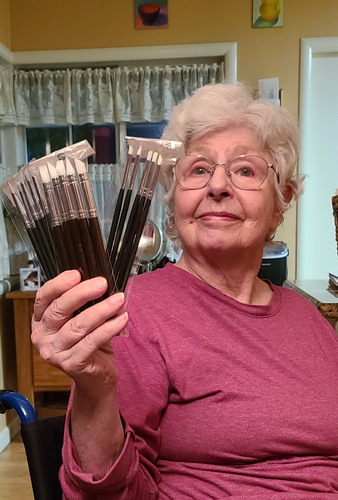 presents. We prefer making presents. It gives us a chance to add a little bit of love into the process. Ellen was working on a design for labels on this years presents when she discovered that she needed a specific type of paint molding tool. Yeah, I didn’t even know such a thing existed. They look sort of like paint brushes except they are made from silicone and are used to move pain around on a surface. Sure enough Amazon had a whole collection for cheap, and the next day Ellen has them in hand.
Volunteering helps Alzheimer’s
In folks with the APOE4 genes for Alzheimer’s, a rec ent large study found that those folks that engaged in helping activities like supporting friends, neighbors, and relatives, had a much slower development of their cognitive decline.
___________________________
~David DeLapp
_____________________________________
Vegan diet challenges the liver
A recent study from the University of Geneva found t hat a purely plant sourced diet compromised the liver’s ability to manage glucose metabolism and eliminate toxic ammonia from the blood within a couple days. Fortunately these difficulties reversed within a couple days once animal products were put back into the diet.
____________________________
“Let what you think, say, feel, and do all be in alignment – this is integrity and is the key to having others trust you. Trust is the essential requirement for successful relationships.“
~David DeLapp
________________________________________
C15 may cut artery plaque in half
So far this is on a mouse model, but it has been fou nd that the supplement C15 (pentadecanoic acid) acts much like statin drugs do on the liver and result in arterial plaque levels being cut in half. We have this in the office!
“When you surrender and let go of your ego’s need to have its way and instead simply be with what is, you open the doors to the next new part of yourself waiting for expression.
~David DeLapp
|
|
|
|
|