One of the most common frustrations I hear from pa tients is this: tients is this:
“I’m doing everything right, but my body doesn’t seem to respond the way it used to.”
Often, the scale moves slowly—or not at all. Energy feels lower. You may feel colder than usual. And yet, lab tests frequently come back “normal.” This can feel confusing and discouraging.
What many people don’t realize is that long before labs change, and sometimes even while weight is still coming off, the body may quietly shift into energy conservation mode. One of the simplest ways we can detect this early is by paying attention to your body temperature, measured correctly and consistently.
This isn’t about obsessing over numbers. It’s about understanding how your metabolism is responding to your current lifestyle and nutrition..
Why temperature matters at all
 Your metabolism is, at its core, the process by which your cells turn food into energy. That process creates heat. When metabolism is robust and well-supported, the body maintains warmth easily. When the brain senses stress—whether from under-eating, over-exercising, poor sleep, illness, or inflammation—it often reduces metabolic output to protect you. Your metabolism is, at its core, the process by which your cells turn food into energy. That process creates heat. When metabolism is robust and well-supported, the body maintains warmth easily. When the brain senses stress—whether from under-eating, over-exercising, poor sleep, illness, or inflammation—it often reduces metabolic output to protect you.
This reduction isn’t a failure. It’s a survival response.
The part of the brain that makes this decision is the hypothalamus. It integrates signals from hormones like thyroid hormone, leptin, insulin, cortisol, and from your nervous system. Based on those signals, it decides how much energy your body is allowed to burn.
When the hypothalamus feels safe, metabolism stays flexible. When it doesn’t, metabolism slows. One of the earli est outward signs of that shift is a lower resting body temperature. est outward signs of that shift is a lower resting body temperature.
From these signals, it decides one crucial thing:
How much energy you are allowed to burn today.
What we are measuring—and why timing matters
To make temperature meaningful, it has to be meas ured under the right conditions. What we’re interested in is your basal waking temperature—your temperature before your body has had a chance to “rev up” for the day. ured under the right conditions. What we’re interested in is your basal waking temperature—your temperature before your body has had a chance to “rev up” for the day.
This means measuring your temperature immediately upon waking, before you get out of bed, before you eat or drink, and before you start moving around or talking. This quiet moment gives us a snapshot of how active your metabolism is at rest.
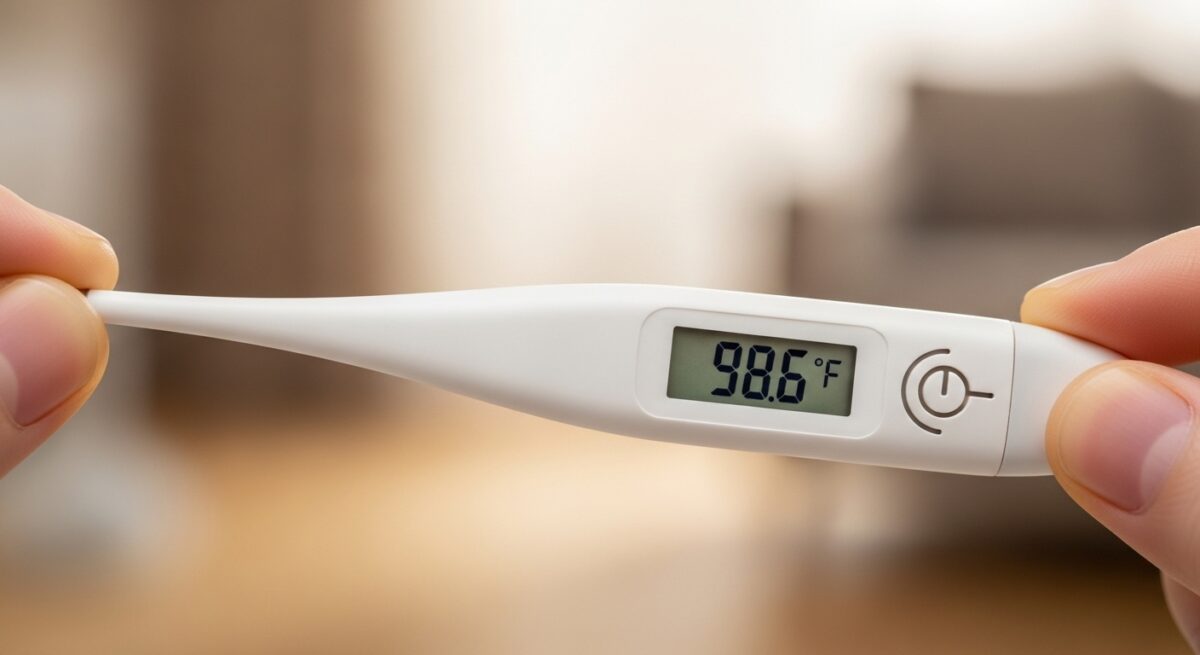
You don’t need a special device. A simple digital oral thermometer is sufficient. What matters most is consistency—using the same thermometer, the same method, at the same time each morning.
What your temperature is really reflecting
Your morning temperature is not diagnosing diseas e. It is reflecting how much energy your body is producing at rest, given its current signals and priorities. e. It is reflecting how much energy your body is producing at rest, given its current signals and priorities.
When temperature is stable and within a healthy range, it suggests that thyroid hormone is working at the tissue level, mitochondria are producing adequate heat, and the brain does not perceive ongoing threat or scarcity.
When temperature trends lower over days or weeks, it often means the body has shifted into conservation mode. This can happen even in people who are losing weight, eating “clean,” or following a well-structured plan. The body may still comply for a while—but at a cost.
Understanding the numbers (without overthinking them)
For most adults, a healthy morning oral temperatur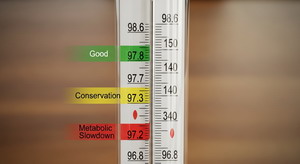 e tends to fall roughly between 97.8 and 98.2°F (36.6–36.8°C). Temperatures consistently in this range suggest good metabolic signaling. e tends to fall roughly between 97.8 and 98.2°F (36.6–36.8°C). Temperatures consistently in this range suggest good metabolic signaling.
Readings in the 97.3–97.7°F (36.3–36.5°C) range are more ambiguous. They often indicate adaptation—your body is getting by, but it may be starting to conserve energy.
Temperatures consistently below 97.3°F (36.3°C) usually suggest that metabolism is being intentionally downregulated. Below 97.0°F (36.1°C) is a stronger signal that recovery, nourishment, or stress support may be needed.
What matters most is not a single number, but the trend. One low day doesn’t mean much. A gradual downward drift over a week or two is far more informative.
How temperature behaves with dieting and fasting

It’s normal for temperature to dip slightly on days of reduced intake or fasting. A healthy system is flexible—it can temporarily downshift and then rebound.
What we want to see is a recovery of temperature after normal eating days, especially when carbohydrates are reintroduced. When temperature rises again within a day or two, it tells us the system still trusts the environment.
If temperature stays low despite adequate food and rest, that suggests the body no longer feels reassured. This is often when plateaus, fatigue, and frustration begin.
Using temperature as feedback, not judgment

Temperature tracking isn’t about pushing the number higher. It’s about listening.
If your temperature is stable and you feel well, your current plan is likely metabolically tolerated—even if fat loss is gradual.
If your temperature is slowly declining, that’s useful information. It often means we need to adjust something: perhaps adding more consistent carbohydrates, reducing fasting frequency, improving sleep, or allowing true maintenance days.
If temperature rebounds clearly after eating more, that’s a positive sign. It does not mean you “undid progress.” It means your metabolism responded to reassurance.
Why this matters for long-term success

Many people lose weight while their metabolism is slowing. That weight loss often feels harder and harder to sustain—and regaining becomes more likely.
Our goal is different. We want fat loss that occurs with metabolic permission, not against it. Temperature gives us an early window into whether your body is cooperating or quietly resisting.
This is especially important if you have dieted repeatedly in the past, followed low-carbohydrate or fasting protocols, are under significant life stress, are recovering from illness or antibiotics, or are older. These situations often require more reassurance, not more restriction.
A final perspective
Your body is not broken. It is responsive.
Temperature tracking allows us to replace guesswork with gentle feedback. Instead of forcing progress and hoping for the best, we can make small, timely adjustments that keep your metabolism supported.
When we listen early, we don’t have to repair damage later.
If you choose to track your temperature, do so with curiosity, not judgment. Think of it as a conversation your body is having with you—one that becomes clearer the more consistently you listen.
Ellen has been home for a week now. Rehabilitation is a slow process. We are able to get her up into a wheelchair for an hour at a time three times a day. She can roll sideways in bed, but she still can not sit up without help. Her acute pain has shifted down to a chronic ache. So things are improving slowly. is a slow process. We are able to get her up into a wheelchair for an hour at a time three times a day. She can roll sideways in bed, but she still can not sit up without help. Her acute pain has shifted down to a chronic ache. So things are improving slowly.
| 5 minutes of exercise boosts longevity |
|