
Understanding the Building Blocks of Human Connection
 What makes your best friend different from a work colleague? Why does a romantic partnership feel distinct from a deep friendship? The answer lies in a fascinating framework that views relationships not as fixed categories, but as unique combinations of six fundamental elements. Understanding these building blocks can transform how you navigate, nurture, and make sense of the connections in your life.
The Six Core Elements
Every meaningful relationship in your life is constr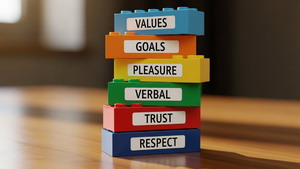 ucted from some combination of six core feeling stances—emotional orientations we take toward another person. These aren’t skills or behaviors, but rather the fundamental feelings that characterize how we relate to someone.
1. Trust
Trust is the foundation of openness and vulnerab ility. When trust is present, you can lower your defenses and share your authentic self without fear of betrayal, judgment, or harm. Trust allows you to admit mistakes, express doubts, and reveal parts of yourself you might otherwise keep hidden. It’s the element that answers the question: “Can I be safe with you?”
2. Respect
Respect is the recognition of another person’s inherent worth and autonomy. When you respect someone, you value their perspectives even when they differ from yours, honor their boundaries, and treat their choices as legitimate. Respect prevents you from dismissing, controlling, or speaking over someone. It says: “You are a person of dignity whose views and decisions matter.”
3. Verbal intimacy
Verbal intimacy and sharing of feelings is the eleme nt of emotional openness and deep conversation. This is where you discuss not just facts and events, but your inner world—your fears, hopes, vulnerabilities, and emotional experiences. It’s the difference between talking about what you did today and sharing how you felt about it, what it meant to you, or what you’re struggling with beneath the surface.
4. Pleasurable physical intimacy
Pleasurable physical intimacy encompasses the real m of physical connection and attraction. This includes romantic and sexual intimacy, but also the particular quality of physical closeness that defines romantic relationships—the desire to touch, hold, and be physically near someone in ways that are distinctly different from platonic connection.
5. Common goals
Common goals mean sharing objectives and working together toward something. This might be a work project, building a life together, raising children, training for a marathon, or any shared endeavor where you’re moving in the same direction with aligned purposes. Common goals create a sense of partnership and teamwork.
6. Common beliefs
Common beliefs and feelings go deeper than shared g oals—it’s about fundamental alignment in how you see and feel about the world. This includes shared values, similar perspectives on important matters, compatible worldviews, and emotional resonance. When this element is present, you often find yourselves naturally agreeing, understanding each other’s reactions without explanation, and feeling like you’re “on the same wavelength.”
How Elements Combine to Create Different Relationships
The remarkable insight of this framework is that diffe rent relationships aren’t just variations on a theme—they’re actually different combinations of these elements, like distinct chemical compounds made from the same basic elements.
A friend is someone with whom you have trust, respect, and verbal intimacy (elements 1, 2, and 3). You can share your feelings openly, you trust them with vulnerable information, and you regard each other with genuine respect. This creates the warm, supportive connection we recognize as friendship.
A great friend adds common beliefs and feelings to the mix (elements 1, 2, 3, and 6). Not only can you share openly and trust each other, but you also fundamentally align in how you see and feel about things. This is the friend who “gets” you without lengthy explanations, who shares your core values and perspectives. These friendships often feel effortless and deeply validating.
A lover is defined primarily by pleasurable physical intimacy (element 4). This might be someone you’re attracted to and physically intimate with, but without necessarily having the other elements present. While this can be enjoyable, it remains limited in depth without additional elements.
A great lover combines physical intimacy with verb al intimacy and emotional sharing (elements 4 and 3). Here you have both the physical connection and the ability to communicate about desires, feelings, and experiences. This transforms physical intimacy from purely sensory to emotionally meaningful.
A coworker is someone with whom you share common goals (element 5). You’re working toward the same objectives, but the relationship may not include trust with personal matters, deep respect for each other as whole people, or emotional sharing beyond what work requires.
A great coworker adds trust and respect to shared g oals (elements 5, 1, and 2). You’re not only working toward the same ends, but you can rely on each other, trust each other’s judgment and integrity, and maintain genuine respect for each other’s contributions and dignity. These are the colleagues who make work deeply satisfying.
A companion brings together trust, respect, verbal intimacy, and common goals (elements 1, 2, 3, and 5). This is someone you can both work alongside and share your inner life with—perhaps a business partner with whom you’ve also built real friendship, or a close friend with whom you’re also pursuing shared projects or life goals.
A great companion includes all of the above plus com mon beliefs and feelings (elements 1, 2, 3, 5, and 6). You’re aligned in your worldview and values, share deep emotional intimacy, work together toward shared goals, and maintain trust and respect throughout. These relationships often feel like finding your “people”—those rare connections where multiple dimensions of compatibility align.
A spouse in its basic form combines trust, physical intimacy, and common goals (elements 1, 4, and 5). You’re building a life together, share physical connection, and trust each other with the practicalities and vulnerabilities of shared life. This describes many functional marriages that work on a practical level.
A great spouse incorporates all six elements (1, 2,  3, 4, 5, and 6). This is the ideal many people seek in marriage—someone you trust completely, respect deeply, can share your innermost feelings with, maintain physical intimacy with, build a life alongside, and who shares your fundamental values and worldview. When all elements are present, the relationship becomes multidimensional and deeply fulfilling.
Why This Framework Matters
Understanding relationships through this lens offers several profound benefits for your well-being and interpersonal life.
It explains why relationships feel incomplete. Wh en a relationship feels like something’s missing but you can’t quite name it, this framework helps. Perhaps you’re in a marriage with trust, physical intimacy, and common goals, but lacking verbal intimacy—you share a life but not your inner worlds. Or maybe you have a friendship with verbal intimacy and common beliefs, but trust has been damaged, leaving you unable to be fully vulnerable. Identifying the missing element gives you specific language for what needs attention.
It validates different types of connections. Not every relationship needs all six elements. Your coworker doesn’t need to be someone with whom you share deep feelings or physical intimacy—that would be inappropriate.
Understanding the natural configuration of different  relationship types relieves the pressure to force connections into forms they’re not meant to take. A friend who’s wonderful at elements 1, 2, and 3 doesn’t need element 6 to be valuable in your life.
It helps you understand relationship transitions . Sometimes relationships shift categories. A coworker becomes a great coworker as you develop trust and respect. A lover becomes a great lover as you begin sharing feelings and vulnerabilities. A friend becomes a companion as you start working together toward shared goals. Conversely, the loss of an element can shift a relationship backward—a great friend who betrays your trust might revert to a more superficial connection.
It guides relationship repair. When a relationship is struggling, you can ask: Which elements are present? Which have weakened or disappeared? A marriage might maintain physical intimacy and common goals but have lost verbal intimacy—you’ve stopped sharing feelings and talking about what matters. Or perhaps respect has eroded through years of criticism and dismissiveness. Identifying the damaged element gives you a specific target for repair work.
It clarifies compatibility. Some people are capable  of certain elements but not others, or they prioritize different elements than you do. Someone might be wonderful at verbal intimacy and sharing feelings but incapable of true trust. Another person might share your beliefs and goals but lack interest in emotional intimacy. Understanding this helps you assess whether a relationship can realistically provide what you need, or whether you’re trying to force an element that simply isn’t there.
It helps you recognize when to let go. Sometime s you realize that a relationship fundamentally lacks elements that are essential to you, and that building them isn’t possible or desired by the other person. A marriage without respect or trust, where those elements can’t be rebuilt, may not be sustainable. A friendship without verbal intimacy when that’s what you need won’t satisfy you. This framework can give you permission to acknowledge when a relationship’s configuration doesn’t work for you.
Applying This to Your Life
Consider mapping your important relationships u sing these six elements.
For each significant person in your life, ask yourself which elements are present. You might discover patterns—perhaps you have many friends with elements 1 and 3 (trust and verbal intimacy) but few with element 6 (common beliefs), leaving you feeling understood but not quite “at home” with anyone. Or maybe your marriage has elements 1, 4, and 5 (trust, physical intimacy, common goals) but is missing element 3 (verbal intimacy), explaining why it feels functional but emotionally distant.
Also, reflect on which elements you’re capable of o ffering. Are you able to extend trust? Do you naturally share feelings and create verbal intimacy? Can you maintain respect even during conflict? Understanding your own strengths and limitations helps you understand what kinds of relationships you can realistically build and sustain.
Remember that elements can be developed over time with intention and effort. Trust builds through consistent reliability. Respect deepens through practice in valuing others’ autonomy. Verbal intimacy grows as you risk sharing more of your inner world. Common goals emerge as you undertake projects together. Even common beliefs and feelings, while often present naturally, can deepen through shared experiences and conversations.
The richest relationships in your life likely contain multiple elements, creating those multidimensional connecti ons that feel irreplaceable. Understanding what makes them special—and what might be missing from relationships that feel lacking—empowers you to invest your energy wisely, communicate your needs clearly, and build the kinds of connections that truly nourish your life.
Take care,
David
Ellen
Well, Ellen is still in the rehab facility. Not much progress has happened, although part of that is because of the timing. Between the transfer on Christmas day and then a holiday weekend, there was not the usual PT staff present at the facility. Her pain was too great for her to be able to participate with the holiday staff. I was not until Wednesday that an official intake with the head nurse and head PT person that they really started addressing her pain levels. Unfortunately by upping the pain meds Ellen now feels disconnected from her body and is having difficulty focusing on here and now. I am telling her that it is just a temporary vacation from reality so she can do the exercising necessary to get her out of this place. Eventually it will all be okay.
|