
If you’ve ever lost weight only to feel colder, more ti red, less motivated, and eventually stuck, you didn’t fail.
Your body did exactly what it was designed to do.
For decades, weight loss has been framed as a simple math equation: eat less, move more. But human physiology doesn’t work like a spreadsheet. Calories matter — but they are not the master switch. That role belongs to a small but powerful part of the brain called the hypothalamus.
Understanding this changes everything.
Meet Your Metabolic Control Center
The hypothalamus sits deep in the brain and ac ts as the body’s central command center for survival. Its job is not to help you fit into smaller clothes. Its job is to keep you alive.
To do that, it constantly monitors:
- Energy availability
- Body temperature
- Stress levels
- Inflammation
- Sleep and circadian rhythm
- Hormonal signals like leptin, insulin, cortisol, and thyroid hormones

How much energy you are allowed to burn today.
That decision determines:
- Your metabolic rate
- How warm or cold you feel
- Your spontaneous movement (NEAT)
- Hunger and cravings
- Whether fat loss feels easy or impossible
This is what we mean by metabolic permission.
When calories are continuously restricted, es pecially alongside low carbohydrates, high stress, poor sleep, or excessive exercise, the hypothalamus receives a clear message:
“Food is scarce and unpredictable.”
In response, it protects you by:
- Lowering thyroid output (especially T3)
- Reducing leptin signaling
- Increasing cortisol tone
- Conserving fat
- Reducing energy expenditure
Weight may still go down for a while — but metabolism quietly slows in the background.
This is why many people say:
- “I’m eating less than ever, but nothing is happening.”
- “I’m losing weight, but I feel awful.”
- “I regain weight the moment I eat normally again.”
The hypothalamus never felt safe.
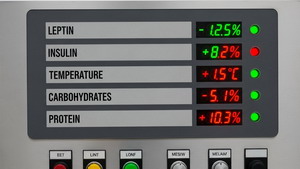
Here’s the key shift:
The hypothalamus does not count calories.
It interprets signals.
The most important safety signals include:
- Leptin pulses (which depend on feeding, not starvation)
- Insulin rises (especially from carbohydrates)
- Stable body temperature
- Predictable eating patterns
- Adequate protein
- Low chronic inflammation
- Regular sleep and circadian rhythm
When these signals are present, the hypothalamus allows fat loss without pulling the brakes.

Many people respond to stalls by:
- Cutting calories further
- Adding more cardio
- Removing carbohydrates completely
- Skipping more meals
From the brain’s perspective, this confirms danger.
More restriction does not convince the body to let go of fat — it convinces it to hold on tighter.
True metabolic success comes from earning trust, not enforcing control.
Fat loss that preserves metabolism includes per iods of reassurance.
This might include:
- Alternating low-calorie days with normal feeding days
- Planned carbohydrate intake (not random “cheat meals”)
- Maintenance days where weight loss is not the goal
- Adequate protein to protect muscle
- Consistent sleep and light exposure
- Managing stress, not glorifying it
These signals tell the hypothalamus:
“Energy is available. We are not in danger.”
Only then does it allow higher energy output.
 Clean)
Carbohydrates are not just fuel. They are information.
They:
- Raise insulin briefly
- Refill glycogen
- Increase leptin signaling
- Support thyroid hormone conversion
- Improve body temperature
- Reduce stress hormone tone
This is why long-term very low-carb dieting often leads to:
- Feeling cold
- Low energy
- Plateaued fat loss
- Sleep disruption
For many people, regular carbohydrate intake is not optional if metabolism is to remain healthy. Regular means consuming carbs every 4 to 7 days with a load of 100 to 250 grams of carbohydrates during the day. The lower load is if you are insulin resistant, and more toward the higher end if your basal temperature is reading colder.

One of the simplest ways to know whether your hypothalamus feels safe is by body temperature.
A chronically low morning temperature often reflects:
- Reduced thyroid signaling
- Energy conservation
- Metabolic adaptation
Weight loss can continue for a time — but it’s happening under stress.
When temperature stabilizes or rises after feeding, it’s a sign that metabolic permission has been restored.
Not everyone’s hypothalamus responds the sam e way.
People who often require more frequent reassurance include:
- Those who have dieted repeatedly
- Lean or athletic individuals
- Post-antibiotic patients
- People with autoimmune conditions
- Older adults
- Anyone under high life stress
For these individuals, aggressive restriction almost always backfires.

Here is the most important takeaway:
Your body is not resisting fat loss — it is responding to perceived threat.
When the hypothalamus senses safety:
- Metabolism stays high
- Fat loss proceeds smoothly
- Energy remains stable
- Weight is easier to maintain
When it senses danger:
- Fat is defended
- Energy drops
- Hunger increases
- Regain becomes likely
This is not weakness.
This is biology.

Successful, lasting fat loss is not about suffering harder.
It is about:
- Strategic cycles, not constant restriction
- Planned abundance, not deprivation
- Predictability, not chaos
- Cooperation with your physiology, not war against it
When you earn metabolic permission, fat loss becomes a by-product of a calm, confident system, not a battle of willpower.
The hypothalamus decides how much energy yo u are allowed to burn.
Your job is not to force it —
Your job is to convince it that it’s safe.
When you do, your metabolism stops fighting you — and starts working with you.
Take care,
David
Ellen
 a five day extension on her stay at the rehabilitation facility to try to improve her mobility. Not much progress was achieved, so she was sent home Friday. We were able to get her into bed Friday night and then get her up Saturday morning, only to discover that after over 3 weeks of laying in bed she had developed the dreaded bed head. Some serious brushing was in order! The next few weeks will be focused on rebuilding muscle strength so she can si
 t up without help and transfer into her wheelchair.
|
|
Laughing gas for depression?
It has been found that a 1 hour treatment of laughin g gas can relieve many symptoms of depression for up to a week. Research continues to see if repeated treatments might produce longer clinical effects.
___________________________
~David DeLapp
_____________________________________
Quitting smoking is difficult and lots of different typ es of support exist to help you quit. Many types of phone apps have been developed to support this process and this recent study concludes that they really do help quite a bit.
____________________________
“If you don’t feel it then no one hears you. People listen for emotion in your words. If there is no emotion or passion then they pay little attention to what is being said.“
~David DeLapp
________________________________________
Bamboo – the next superfood
Many cultures already consume bamboo as part of t heir natural diet. Research is showing how good bamboo is for you. It helps control blood sugar, fight inflammation, improve gut health, and is an antioxidant.
________________________
“Pleasure Is the present moment experience of abundance; excitement is the hope of overcoming lack. Pleasure is an inside-out appreciation of what is while excitement is the anticipation that you will be able to fill your emptiness with something from the outside.“
~David DeLapp
|
|