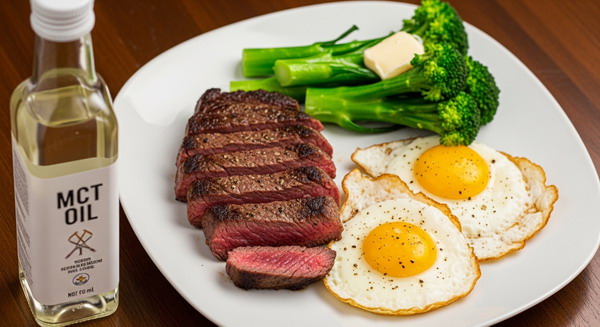
I want to share some exciting developments in how we can support brain health, particularly for those experie ncing memory concerns or cognitive changes. Research has shown promising results using a natural approach that helps your brain work more efficiently.
The Brain’s Energy Challenge
Your brain is an energy-hungry organ, using about  20% of your body’s fuel despite being only 2% of your body weight. Normally, your brain runs primarily on glucose (sugar) from the foods you eat. However, as we age or when certain conditions like Alzheimer’s disease develop, the brain can lose its ability to use glucose efficiently. Think of it like a car that’s having trouble using regular gasoline – the engine still works, but it needs a different type of fuel.
Enter Ketones: Your Brain’s Alternative Fuel
Fortunately, your brain has a backup fuel system: ketones. Ketones are natural compounds your body produce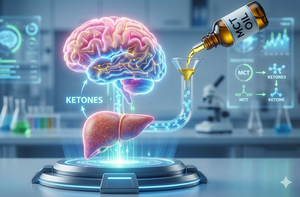 s when it breaks down fat for energy. The remarkable thing is that even when the brain struggles to use glucose, it can often still use ketones effectively. This is why ketones have shown real promise in supporting cognitive function.
Clinical studies have demonstrated that when people with memory problems use ketones as brain fuel, many experience improvements in cognitive function. This isn’t just theory – it’s been measured in real patients with real results.
Two Pathways to Ketones
I want to introduce you to two evidence-based ap proaches for increasing ketones to support your brain health. The right choice depends on your lifestyle, preferences, and support system.
Option 1: MCT Oil Supplementation
MCT stands for “medium-chain triglycerides” – a special type of fat found naturally in coconut oil and palm kernel oil. When you consume MCT oil, your liver quickly converts it into ketones that your brain can use for fuel.
The advantages of MCT oil:
- Simple to add to your current diet
- Works within 1-3 hours of taking it
- No major lifestyle changes required
- The approach used in clinical studies showing cognitive benefit
- Easy to adjust the dose to your needs
How to use it:
Start with one teaspoon per day, mixed into coffee, smoothies, or salad dressing. Gradually increase over several weeks to 2-3 tablespoons daily. Some people experience digestive upset if they increase too quickly, so patience is important. Taking it with food often helps minimize any stomach discomfort. This is in the office as Brain Boost.
Option 2: Ketogenic Diet
A ketogenic diet is a low-carbohydrate, high-fat e ating approach that shifts your body into producing ketones naturally throughout the day. This typically means eating meat, fish, eggs, cheese, nuts, seeds, low-carb vegetables, and healthy fats while eliminating bread, pasta, rice, sugar, and starchy foods.
The advantages of a ketogenic diet:
- Produces higher and more sustained ketone levels
- May provide additional health benefits beyond brain support
- No supplements needed
- Can be very satisfying with reduced hunger
- Well established as an optimum weight loss aid
The challenges:
- Requires significant dietary changes and plannin
 g
g - Takes time to learn and adapt
- Works best with family support or a dedicated caregiver
- Needs more monitoring and guidance
A Middle Path
Some patients find success combining both approaches – following a lower-carbohydrate diet while also using MCT oil. The MCT oil helps stimulate the ketone production pathways in the liver making it easier to get into the ketogenic state than diet alone.
Measuring Your Success: Ketone Monitoring
One of the most empowering aspects of this approach is that you can actually measure whether it’s working. Just as people with diabetes check their blood sugar, you can check your ketone levels to ensure you’re producing the ketones your brain needs.
There are several ways to measure ketones:
Breath meters measure acetone (a type of ketone) i n your breath – no finger pricks required. These devices are reusable and great for tracking trends over time.
Blood meters provide the most accurate measurement of beta-hydroxybutyrate (the main ketone your body produces). They require a finger stick and test strips.
Urine strips are the least expensive option but become less accurate over time as your body adapts.
For most people, I recommend breath ketone monitoring as a practical way to track your progress and confirm that your MCT oil or dietary changes are producing ketones.
What to Expect
The goal is to achieve mild ketosis – enough keto nes to support brain function without the higher levels needed for other medical purposes. You’re looking for consistent, sustainable elevation rather than extreme numbers.
Most people notice:
- Ketone levels rising within 1-3 hours after taking MCT oil
- Better mental clarity and focus
- More stable energy throughout the day
- Gradual improvements in cognitive function over weeks to months
The Bottom Line
Supporting brain health doesn’t have to be compli cated. Whether through simple MCT oil supplementation or a more comprehensive dietary approach, providing your brain with ketones offers a scientifically-supported way to help maintain and potentially improve cognitive function.
Every patient is different, and what works beautifully for one person may need adjustment for another. That’s why I’m here – to help you find the approach that works best for your unique situation.
If you have questions or want to explore whether this approach is right for you, please don’t hesitate to ask questions at your next visit. Your brain health is worth the investment.
David
Ellen
Everyone asks me how Ellen is doing. I answer that she is improving about 1% each day. Recovery from her level of muscle loss on top of her already existing left sided loss of fu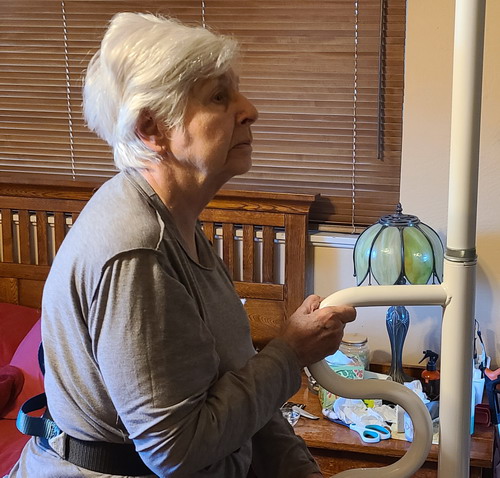 nction from her stroke 10 years ago makes recovery challenging. But each day we make a little progress. Here Ellen is practicing standing up with the help of a pole I set up beside the bed. I have to help her sit up and then pull her legs over the edge of the bed so she can face the pole. Then with her arm strength assisting her legs, she is able to pull herself upright for about 10 seconds at a time. Gradually this will build her leg strength enough that she will be able to stand up without the pole.
Vitamin D needed for lung health
We all know we need vitamin D for bones, but how  many are aware that vitamin D is essential for the immune system to protect our lungs during flu season.
___________________________
~David DeLapp
_____________________________________
Micronutrient deficiency
Significant portions of the population suffer from m icronutrient deficiencies such as iron, iodine, zinc, vitamin A and C, B12, and so on. For instance WHO reports 40% of children under age 5 suffer from anemia due to low iron. And over 300 million children suffer from vitamin A deficiency. Half of the worlds population has one or more micronutrient deficiency.
____________________________
“Don’t try to fix people. They are not broken. They are brilliant puzzle solvers working on their current puzzle. To try to fix them is to take away their puzzle. When someone is not okay they need empathy. They are not ready for more. When they want more, then support/guide them. “
~David DeLapp
________________________________________
Diets high in ultra processed foods produce a 47% increase of heart disease
Today in America ultra processed foods make up 60% of adults diets and 70% of children’s diets. This is not a good thing for our health.
________________________
“No one grows from a state of judgment. Feeling judged by self or others shuts you down and makes you defensive – not a place you can grow from.“
~David DeLapp